
A guest with a nut allergy, a table with two vegans, a wedding where a quarter of the guests eat something different. Dietary needs are part of the job. Yet things still go wrong, with the information on the menu or with the communication between the floor and the kitchen. This article sets out what the rules ask, how many guests have a preference or restriction, and how to ask about dietary needs in time for reservations and events. It isn't legal advice. If you're unsure what applies to your business, check with the Dutch food authority, the NVWA.
What the EU asks: 14 allergens
The basis is a European regulation: Regulation (EU) No 1169/2011 on the provision of food information to consumers. Article 44 covers food you sell or serve without packaging, as in a restaurant or by a caterer. For that food, information on allergens is mandatory (Regulation (EU) No 1169/2011).
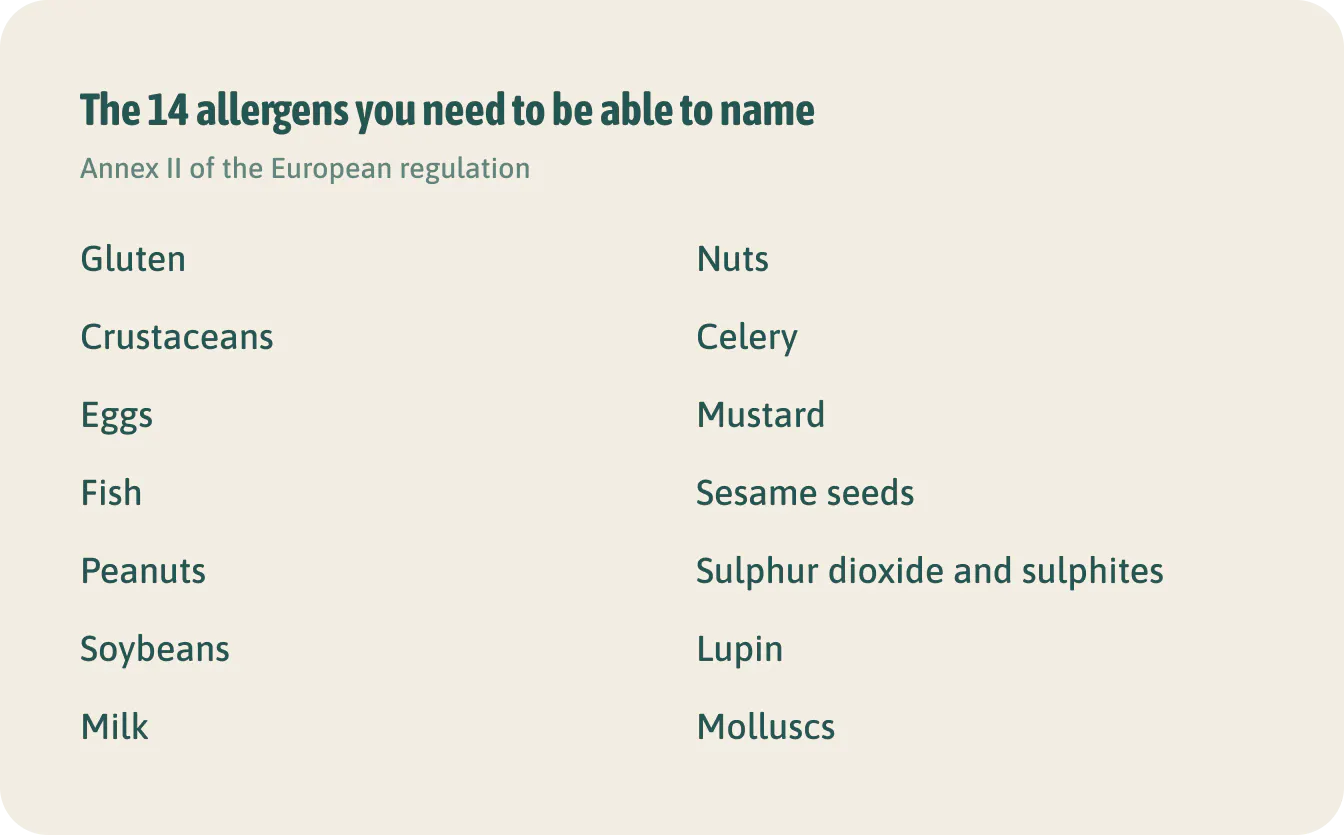
Annex II of the regulation lists the allergens concerned. There are 14:
- Cereals containing gluten
- Crustaceans
- Eggs
- Fish
- Peanuts
- Soybeans
- Milk
- Nuts
- Celery
- Mustard
- Sesame seeds
- Sulphur dioxide and sulphites
- Lupin
- Molluscs
Lactose isn't listed separately. It falls under milk: Annex II lists "milk and products thereof (including lactose)". Lactose intolerance isn't an allergy either, but an intolerance. For a guest, that makes little difference. For the law, it does.
Telling guests verbally is allowed, but not on its own
In the Netherlands, the Netherlands Food and Consumer Product Safety Authority (NVWA) enforces these rules. The NVWA explains how they work for unpackaged food. They apply to hospitality, catering and care institutions, among others (NVWA). The NVWA doesn't mention events separately. We assume a caterer serving at an event falls under the rules, but check this for your own situation.
The main points:
- In writing or verbally. You can put allergen information on the menu or on cards. You can also tell guests verbally.
- Verbal needs a notice. If you choose to tell guests verbally, there must be a notice somewhere saying guests can ask.
- Always available straight away. You or your staff must be able to give the information to the guest immediately. For that, it must also be available to staff in writing or electronically.
- Name the type. For cereals containing gluten and for nuts, you must say which ones. "Nuts" isn't enough; "hazelnut" is.
So verbal is never only verbal. Behind what the floor staff say, there has to be a list that matches what happens in the kitchen.
How often it goes wrong
That last part turns out to be hard. In 2023, the NVWA inspected 6,548 businesses that sell unpackaged food. More than half didn't comply with the rules on allergen information. In 2,008 inspections (30.7%), there was no allergen information at all. In 1,081 inspections (16.5%), the information was given only verbally, with nothing in writing or digital to back it up. That's what the Dutch news outlet Hart van Nederland reported in February 2024, based on NVWA figures.
That second group is instructive. These aren't businesses that do nothing, but businesses where the knowledge lives in people's heads. That works until the chef is ill, the menu changes or a new member of staff gets the question.
How many guests have dietary needs
The number of guests with a preference is large. According to Statistics Netherlands (CBS), 0.5% of Dutch people were vegan in 2023, 2.3% vegetarian and 2.1% pescatarian. Together, that's about 5% who eat no meat. On top of that, 21.7% went without meat at their main meal at least three times a week. A quarter of all main meals were vegetarian (CBS, 2024).
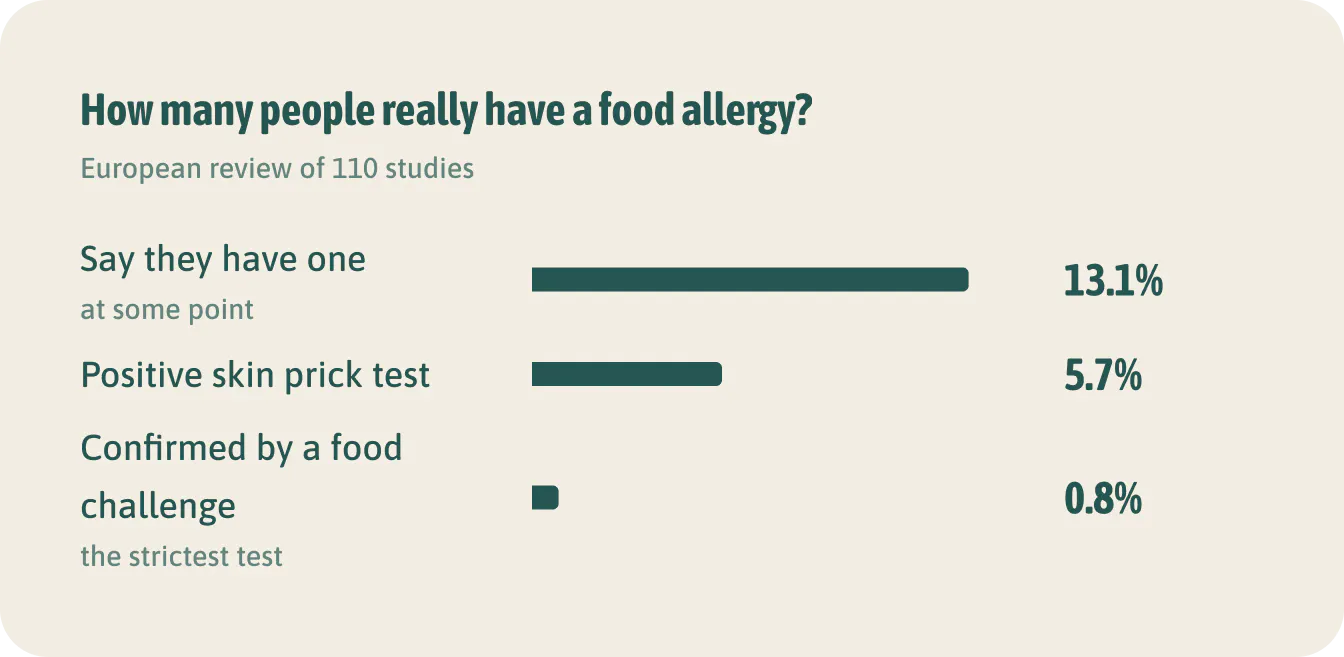
For allergies, the picture is more complicated. A European review of 110 studies found that 13.1% of people say they currently have a food allergy. With a skin prick test, 5.7% tested positive. With a food challenge, the strictest test, it was 0.8% (Spolidoro et al., 2023).
What does that mean for hospitality? Not that you should take guests with an allergy less seriously. You don't know who belongs to the 0.8%, and a mistake can be serious. It does mean you'll get a lot of requests, from people with very different needs. Some avoid a product; others can't have even a trace of it. That's why it helps to know in advance who needs what, and to ask the guest how strict it is.
Why asking in advance lowers the risk
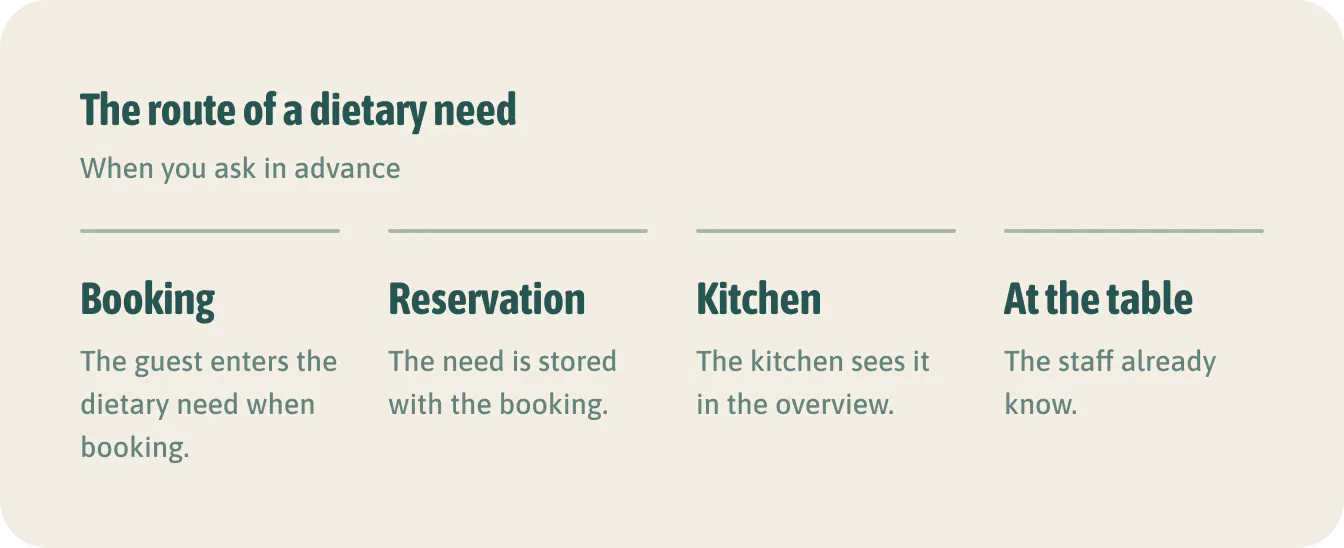
With allergens, a lot can go wrong in the handover. The guest tells the floor staff, the floor staff forget to pass it on, or the kitchen only hears when the plate is already on the pass. The later a need becomes known, the more links there are in the chain, and the less time to think it through.
Ask about dietary needs when guests book or register, and that changes:
- The kitchen knows before service. There's time to check which dish fits, or to adapt something.
- It's written down. Not in someone's head, but with the reservation. Anyone who opens the reservation sees it.
- You can follow up. Is "nuts" a preference or a severe allergy? You'd rather ask the day before than at the table.
Why asking in advance cuts waste too
The same information helps against waste. If the kitchen doesn't know how many guests need a vegetarian or gluten-free dish, it makes extra to be safe. That's why the U.S. Food Waste Pact flags overproduction of special meals as a point of attention for event planners (U.S. Food Waste Pact, 2026). The World Medical Association asks people attending meetings to register and state their dietary requirements, so the caterer has an accurate guest count and can plan a menu that avoids waste (WMA, 2022).
When you guess, you cook extra to be safe. When you ask, you don't have to guess. More on waste at meetings and events is in Food waste at events and catering: where it goes wrong.
How to ask about dietary needs in advance
It works slightly differently for a table reservation and for an event.
For reservations
- Make the question part of booking. An optional free-text field gets skipped. A question with a clear "no dietary needs" option gets an answer.
- Ask about the whole party. Someone booking for four needs to know the question covers all four.
- Show it where it's needed. Dietary needs should be visible to the floor and the kitchen, not just sit in an inbox.
- Call back if it sounds serious. A quick question in advance prevents an awkward conversation at the table.
For events
- Ask at registration or with the menu choice. Then you have it for everyone in one place.
- Let guests choose from the menu. Then you also see how many vegetarian or other dishes you need, not just who has a dietary need.
- Give the caterer a list by name and a total. The kitchen needs to know how many; the floor staff need to know who.
- Set a deadline, and stick to it. A request that arrives on the day itself can't be prepared for properly.
Dietary needs are health data
When you ask about allergies or a medical diet, you're asking about someone's health. According to the Dutch Data Protection Authority (Autoriteit Persoonsgegevens, AP), that's special category personal data. In principle you may not process it, unless you meet strict requirements. The first exception the AP names is that the person has given explicit consent (Autoriteit Persoonsgegevens).
In practice, that means: ask only what the kitchen needs, explain what you use it for, and don't keep it longer than necessary. How lawful bases, retention periods and the role of your software provider fit together is covered in Guest data and the GDPR for reservations and events.
How Waste Warrior helps with allergens and dietary needs
In Waste Warrior Reservations, we ask about dietary needs with every booking made through the booking widget. The dietary needs field is required. If a guest has none, they tick the box saying they have no dietary needs. So you always get an answer, even if the answer is "none". The dietary need is then stored with the reservation, so you and your team see it before the guest arrives.
For each dish, you record the allergens. You choose from the 14 EU allergens. When guests choose their dishes in advance, they see the allergens for each dish as icons. Waste Warrior doesn't name the type of cereal or nut separately. Put that in the dish description, so you meet the NVWA's requirement.
In Waste Warrior Events, guests choose their dishes through their personal link. They note a dietary need or allergy in the free-text "Comments" field. You see those comments per guest and in the event's "Totals", next to the number of each dish.
There are two things Waste Warrior doesn't do. It doesn't automatically check a dietary need against a dish's allergens. And it doesn't replace your allergen information. Whether that information is correct and complete remains the responsibility of you and your kitchen.
Curious how that would look for you? Take a look at Waste Warrior Reservations and Waste Warrior Events, or plan a demo. More answers are in the FAQ.