
A lunch for sixty people, a company party, an anniversary at a care home. Events often leave more food behind than an ordinary restaurant service. That's rarely the kitchen's fault. Usually nobody knows exactly how many people will come, who can't eat gluten and who would rather eat vegetarian. This article sets out what the figures say, where things go wrong and what you can do as an organiser or caterer.
How much food is left over at events?
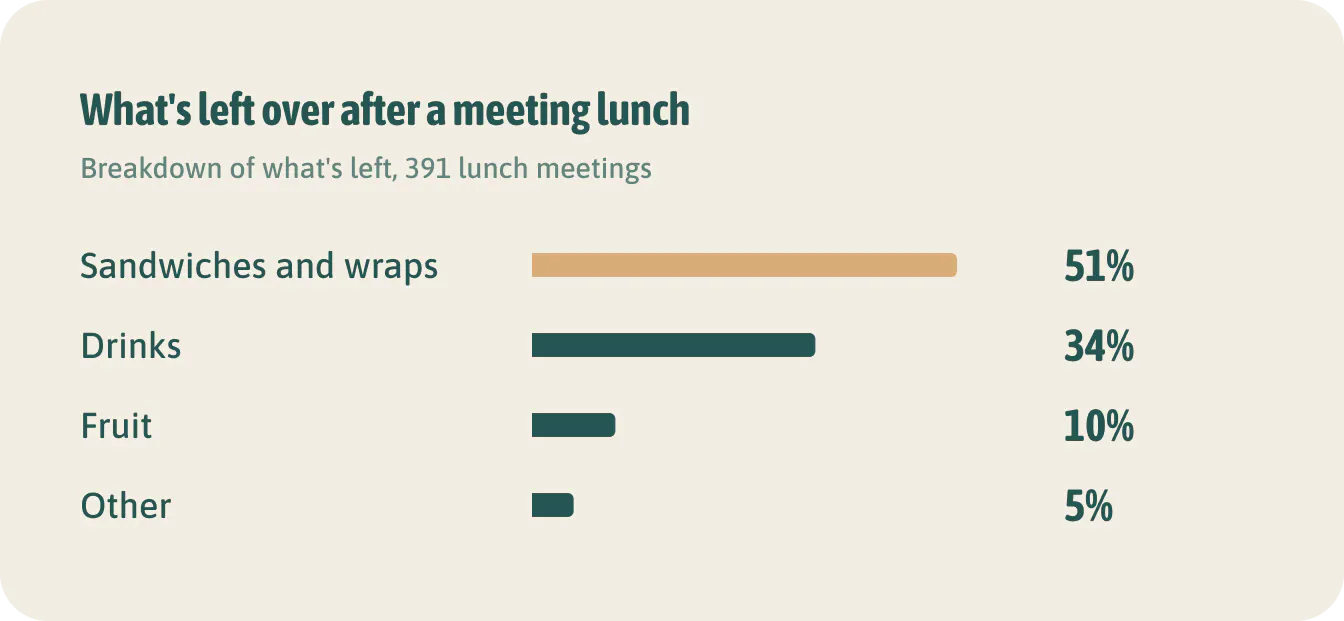
The best Dutch figure comes from the catering sector itself. In 2024, the Dutch foundation Samen Tegen Voedselverspilling, the caterers' association Veneca and Wageningen University & Research mapped what's left over at meetings. At 391 lunch meetings, 78% of the food was eaten and 22% was left over. At 96 coffee meetings, 42% was left over, mostly coffee and tea (Samen Tegen Voedselverspilling, 2024).
Two caveats. The figures are self-reported by eight caterers. And what's left over isn't always thrown away. Even so, the picture is clear: at an average lunch meeting, about a fifth of the food isn't eaten.
Figures from abroad point the same way.
- Business conferences. In a pilot at six conferences in the United States, an average of 42% of the prepared food went uneaten (U.S. Food Waste Pact, 2026).
- Hotel functions. Irish hotels throw away an average of 530 grams of food per guest at events and functions. That counts everything: preparation waste, food that was never served and plate waste (EPA Ireland, 2022).
A quick sum makes that concrete. At a party for 200 guests, 530 grams per guest is over 100 kilos of food. The Irish Environmental Protection Agency estimates that every kilo costs a hotel €3 to €4, covering purchasing, storage, cooking, serving and disposal. That's an Irish average, not a measurement of your events.
Why so much is left over at events
You'd expect an event to be easy to plan. You know the date, the menu and how many people you've invited. The Irish EPA says so too: function numbers are usually known. Yet Irish hotels waste the most of the whole food service sector, and functions stand out even within that.
The U.S. Food Waste Pact looked into why. Its conclusion: large amounts of food go uneaten "not because of intent, but because of fragmented communication, inconsistent planning processes, and the absence of shared expectations between planners and venues". The organiser knows who has cancelled, but the kitchen doesn't hear about it. The kitchen knows how many vegetarian meals it's making, but not how many are actually needed.
Five causes keep coming back:
- Unknown numbers. If you don't know how many people are coming, you cook for the number of invitations. Or a bit more, to be safe.
- No-shows. People who sign up and don't turn up. Especially at free events.
- Buffets. Guests who serve themselves often take more than they eat, and the dishes have to stay full until the end.
- Unknown dietary needs. If the kitchen only learns on the day who eats vegetarian or has an allergy, it has to improvise.
- Oversized special-meal counts. One extra vegetarian or gluten-free meal, just in case. And again for every variant.
The Dutch province of Zuid-Holland studied its own meeting lunches and found two main causes: portions that were too large per person, and no-shows (Provincie Zuid-Holland, 2020).
No-shows: who actually turns up?
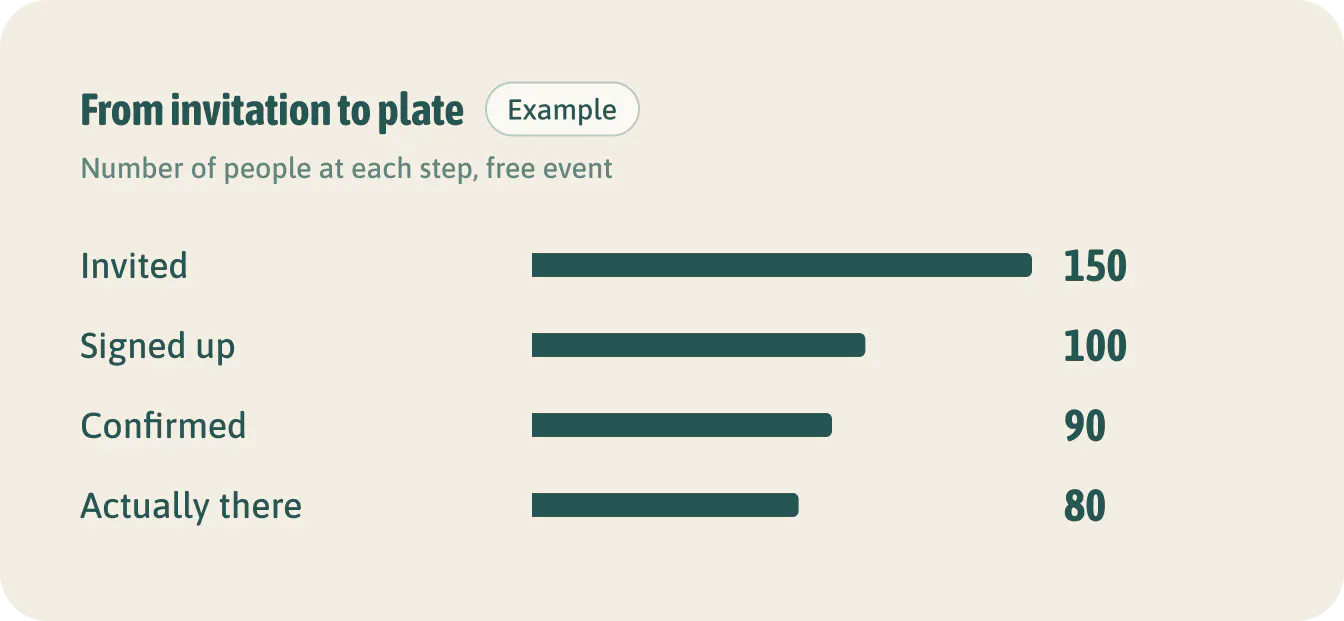
A registration is no guarantee. PheedLoop, an event software vendor, looked at more than 1,070 events with check-in data. On average, one in five registered attendees didn't show up (PheedLoop, 2026).
It's worse at free events. In a follow-up analysis of more than 860 events, the median no-show rate was around 28% at free events, against 17% at paid ones (PheedLoop, 2026). This is the vendor's own data, mostly from business events. But the pattern is familiar. A staff party, a client day or a celebration in a care home costs the guest nothing, so there's no pressure to cancel either.
It happens in the Netherlands too. At the province of Zuid-Holland's own staff restaurant, an average of 25% of the people who signed up for dinner didn't come (Provincie Zuid-Holland, 2020). The province saw timely cancellations and fewer no-shows as one of its biggest chances to cut waste.
What helps? There's little research on events. From healthcare, we do know that a reminder by text message improves attendance at appointments compared with no reminder (Cochrane, 2013). A doctor's appointment isn't a company party, but the mechanism is the same: people who are reminded turn up more often, or cancel in time.
Buffet or set portions?
A buffet feels generous and flexible. For waste, it's a risk. Guests serve themselves and often take more than they eat. And the dishes need to look full until the last guest arrives, so a lot is left at the end.
Research in Slovenian hotels showed that plate waste at buffets depends on the moment. Dinner buffets produce more plate waste than breakfast buffets. A guest's first meal at a hotel, and the presence of children, also lead to more leftovers (Juvan et al., 2021). At Dutch hotel breakfasts, the Hotelmonitor found 62.2 grams per guest left on the buffet, plus another 53.9 grams of plate waste (KHN, 2026). Those are breakfast buffets, not events, but they show that a buffet wastes food in two places.
That's why the World Medical Association's guidelines for sustainable meetings say: serve pre-measured portions at tables rather than a buffet. If a buffet is unavoidable, offer smaller plates (WMA, 2022).
A plated meal does come with a condition. You need to know in advance how many plates you're making, and which ones.
Dietary needs and special meals
More and more guests have a preference or a restriction. According to Statistics Netherlands (CBS), about 5% of Dutch people ate no meat at all in 2023, and a quarter of all main meals were vegetarian (CBS, 2024). On top of that come allergies and intolerances.
If the kitchen only finds out on the day, there are two outcomes. Either there isn't enough, and a guest with an allergy gets a plate of whatever was left. Or there's too much of everything, because the kitchen played it safe.
The second happens a lot. The U.S. Food Waste Pact advises organisers to agree with the venue on how to avoid overproducing special meals (U.S. Food Waste Pact, 2026). A British industry report describes it as common practice for the kitchen to prepare about 10% extra meals for unexpected guests, and to repeat that margin for vegetarian, vegan and free-from meals (Lime Venue Portfolio, 2019). That's a rule of thumb from practice, not a measurement. But offer five variants and you can see how quickly it adds up.
When you guess, you cook extra to be safe. When you ask, you don't have to guess. How to ask about dietary needs and allergens properly, and what the law says about it, is covered in Allergens and dietary needs in hospitality: rules and practice.
What works: the right numbers at the right time
The WMA guidelines, the U.S. Food Waste Pact and the province of Zuid-Holland's approach come down to the same thing. You don't cut event waste in the kitchen, but before it: by making sure the kitchen has the right numbers in time.
- Ask guests to register. Even for a free lunch or a staff party. The WMA asks participants to register and state their dietary requirements, so the caterer has an accurate guest count and can plan a menu that avoids waste (WMA, 2022).
- Set a deadline. An invitation without an end date brings in replies until the very last day. With a deadline, you know where you stand in time.
- Remind those who haven't replied. Not everyone, only the people who haven't answered yet. That saves messages and irritation.
- Ask for dietary needs and dish choices in advance. Let guests choose from the menu and note their dietary needs. Then the kitchen knows how much of each dish it needs, and doesn't have to guess at special meals.
- Run a final confirmation round. Send a last message with the overview a few days before the event. Anyone who can't make it still has a chance to cancel. The U.S. Food Waste Pact recommends sharing attendance insights, such as no-shows, with the venue throughout the event lifecycle (U.S. Food Waste Pact, 2026).
- Share the numbers with the caterer, and update them. A number from three weeks ago isn't a number. Agree when you'll pass on the final count, and cancel what's no longer needed in time. The province of Zuid-Holland names that last point explicitly.
- Choose set portions where you can. Plated service instead of a buffet, or smaller plates if a buffet is the only option.
And finally: measure first. After a few events, weigh or photograph what comes back. Then you'll see whether your approach works, and which part you're still making too much of. How to start is covered in Measuring food waste in restaurants: what it costs and where to start.
Events in care: banqueting counts too
For care organisations, this is more than a hospitality question. Requirement 7.3 of the Milieuthermometer Zorg, the Dutch environmental certification for care organisations, asks you to measure and record kitchen waste, plate waste and banqueting at least once a year (Milieuplatform Zorgsector (MPZ)). Banqueting is the food and drink at meetings and events: the New Year's reception, the meeting lunch, a colleague's farewell.
So it's a stream you can't skip if you're aiming for silver or gold. And it's often a stream where a relatively large share is left over, as the figures on meeting lunches show. How to approach that measurement is covered in Milieuthermometer Zorg: how to measure food waste for requirement 7.3.
How Waste Warrior Events helps you get the numbers right
Waste Warrior Events is built to take the steps above off your hands. You create an event with a menu, the number of guests and how many people each guest may bring (plus-ones per guest). Then you set up the guest list. You import a CSV file with name, email address and phone number, or add guests one by one. If you don't have a fixed list, you share a public registration link and people sign up themselves.
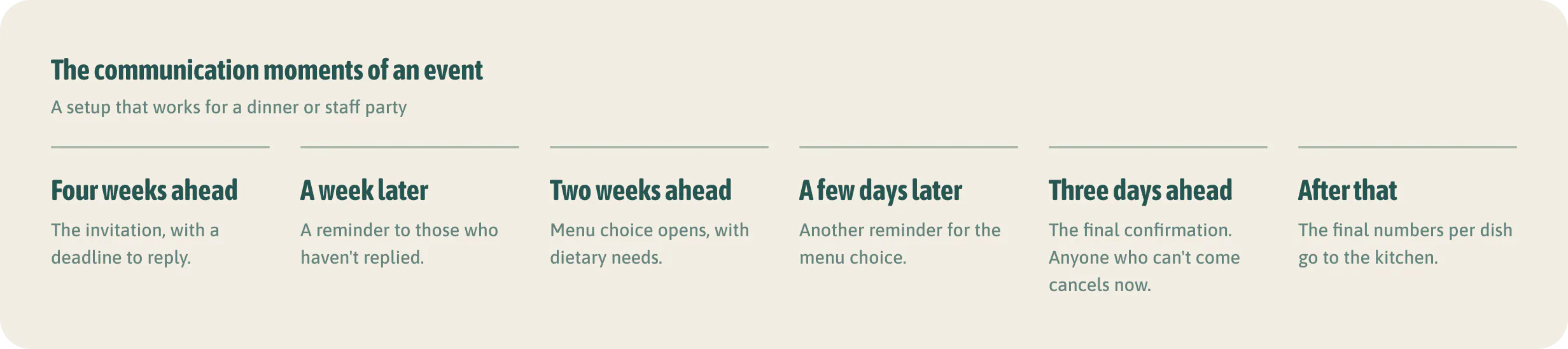
Next, you plan the communication moments. First you ask whether someone is coming, then what they'd like to eat, and finally you send a "Final confirmation". Every invitation has a deadline, and reminders go only to the group you choose, for example the guests who haven't responded yet. If you'd rather not plan it yourself, pick a template. "Sequential" asks about attendance four weeks ahead, asks for the menu choice two weeks ahead and sends the final confirmation three days before. Messages go by email and WhatsApp. Our messaging isn't tied to one channel; we can add another, such as Signal, on request.
Guests don't need an account. They open their personal link, say whether they're coming, choose their dishes and see the allergens for each dish as they do. They note any dietary needs under "Comments". If someone can't make it after all, they cancel with a single button.
In the overview, you see who's coming, who has already chosen and who hasn't replied. Under "Totals", each event shows how much of each dish is needed, with the guests' comments alongside. Those are the numbers you give to the kitchen or the caterer. For each round, you also see what has changed since the previous one: new sign-ups, changed choices and cancellations. Waste Warrior doesn't make a forecast and doesn't weigh anything. It makes sure you know what to prepare. If you also want to measure what's left over, you do that with Waste Warrior Monitor.
How to set up such an event step by step is covered in Organising an event with a guest list and menu choice in advance.
Curious how that would work for your events? Take a look at Waste Warrior Events or plan a demo. More answers are in the FAQ on events.