If you measure food waste with AI and photos, sooner or later the board or the auditor will ask: is it accurate? The honest answer: a photo gives an estimate, not a weighing. Below you'll find what that means, where an estimate is strong and where it falls short, and how to use the figures responsibly.
Weighing is the gold standard, but it takes a lot of work
If you want to know exactly, you weigh. A scale gives grams, and there is little to argue about. That is why a scale appears in most guides to a baseline measurement. MPZ (Milieuplatform Zorgsector), the environmental platform for the Dutch care sector, suggests tally sheets or buckets and a scale, and advises measuring for at least two weeks.
The catch is time. In its methodology for hospitals, Wageningen University & Research (WUR) wrote in 2016 that measuring itself can "only be automated to a limited extent" and that it often comes down to weighing things yourself at the level of detail you need. If you want to know which dish or which ward is the biggest source, you need a bucket per stream and someone to record every weighing. That work often lands on staff who are already short of time.
MPZ adds something telling: measuring is "not about being accurate to the gram". You measure to see where the food goes, so you can change something. Keep that in mind for the rest of this article.
Photographing plates is an established research method
Judging plate leftovers from a photo is not a new idea. Researchers and hospitals have used it for years, because a photo is quick and can be reviewed calmly later.
One example is a validation study in a hospital, presented at the Nutrition Society of Australia conference in 2025. Raters looked at photos of 1,763 plates and estimated what share of the meal was left, on a seven-step scale from 0 to 100%. Those estimates were compared with weighing. The correlation was very high (rs = 0.99) and the mean difference was 4.67 grams.
There are caveats. It is a conference abstract, and the estimates were made by people, not by AI. The spread per plate was also larger: the limits of agreement ran from roughly -50 to +60 grams. Across many plates the picture holds up well, while a single plate can be off by tens of grams. That pattern applies to any visual estimate.
It works in practice too. Ziekenhuis Geel, a hospital in Belgium, photographed the plates that came back and weighed the leftovers. One result: the mashed potato portion went from three scoops to two, because only two of the three were eaten. You don't need gram-level precision to act on an insight like that.
Measuring food waste with AI: what happens to a photo
AI does something similar to such a rater, but for every photo and without anyone having to go through photos afterwards. The model recognises which food is there and estimates how many grams are left, in total and per ingredient. It weighs nothing. That is why a good system labels the result as an estimate.
To reach an estimate, the model uses fixed reference sizes. A plate is about 27 cm, a serving spoon holds about 70 grams, a palm-sized piece of meat weighs about 100 grams and a potato about 150 grams. Because a photo taken from above underestimates height and volume, the model has to account for that. Pans and serving dishes from the kitchen use other references, such as the size of a gastronorm tray.
An estimate gets stronger with context. If it is known what was purchased and served for that meal, the model knows what a normal portion is. It can then estimate what share of a portion came back, instead of guessing from scratch.
There should also be checks on results that cannot be right, such as more leftover of a dish than was ever served. An estimate like that should be capped or flagged, so that someone looks at it.
And a person keeps the last word. If a staff member sees that the AI mistook broccoli for green beans, or judged a portion too heavy, they correct it per ingredient.
Where a photo estimate falls short
Every method has weak spots. With photos, these are the main ones:
- Liquid and mixed food. Soup in a bowl, custard or a mash shows little of its depth.
- Food hidden under other food. No camera sees what is under a napkin or a slice of bread.
- Poor photos. Too dark, at an angle or with no food in view. A good system leaves such a photo out of the count and shows that it is missing, rather than guessing.
- A single plate. As the study above showed, one plate says little. The average over a week says much more.
There is another source of uncertainty that is often forgotten: the denominator. The Milieuthermometer Zorg, the Dutch environmental certification for care organisations, expresses waste as a percentage of purchased weight. If a meal's purchases are unknown and an average is used instead, the percentage is less precise, however good the estimate of the leftovers. So also check how many measurements used real purchase data.
You can only give an accuracy percentage for AI estimates of food leftovers if you have tested it against weighed plates, in your kind of kitchen. If someone promises you a precise error rate, ask what it was measured against.
Why trends and comparisons say more than the exact gram
WUR made a point in the same report that is easy to overlook: a measurement in kilos "says little in itself, because there is no point of reference". The report gives its own example: 200 kilos a day is a problem with 100 residents, but not with 10,000 patients. Kilos only mean something next to purchases, the number of people and the previous period.
That is where an estimate is strong. If you measure the same way every week, you see whether lunch on ward A sends back more than on ward B. You see whether the potatoes after dinner went down once portions became smaller and second helpings became the norm. Whether waste was 18.2 or 18.9% changes nothing about what you will do next.
There are two moments when the precise value does matter:
- Near a threshold. If you are close to the Milieuthermometer Zorg's 20% threshold, or the 15% that applies for gold, you want certainty. Weigh a sample of plates and pans alongside the photos for a week. That way you see for yourself how close the estimates are to your weighing.
- When comparing with a baseline made with another method. If you weighed last year and now measure with photos, you are comparing two methods. Run both for a short period during the switch, or start again with a baseline measurement.
Seven questions for any measurement method
If you are choosing or assessing a method, these questions help. They apply to a scale, a camera above the bin or a photo per plate:
- What is weighed and what is estimated?
- Can staff correct a mistake, and does it stay visible what was changed?
- How does the system handle photos or weighings that fail?
- Is waste set against purchases, so you get percentages instead of loose kilos?
- Can you see per meal, ward and ingredient where the food goes?
- Where are images and data processed?
- If an accuracy is quoted: what was it tested against?
For more background on where waste arises in care and what the standards ask, read Food waste in healthcare: what it costs and how to measure it.
How Waste Warrior Monitor handles estimates
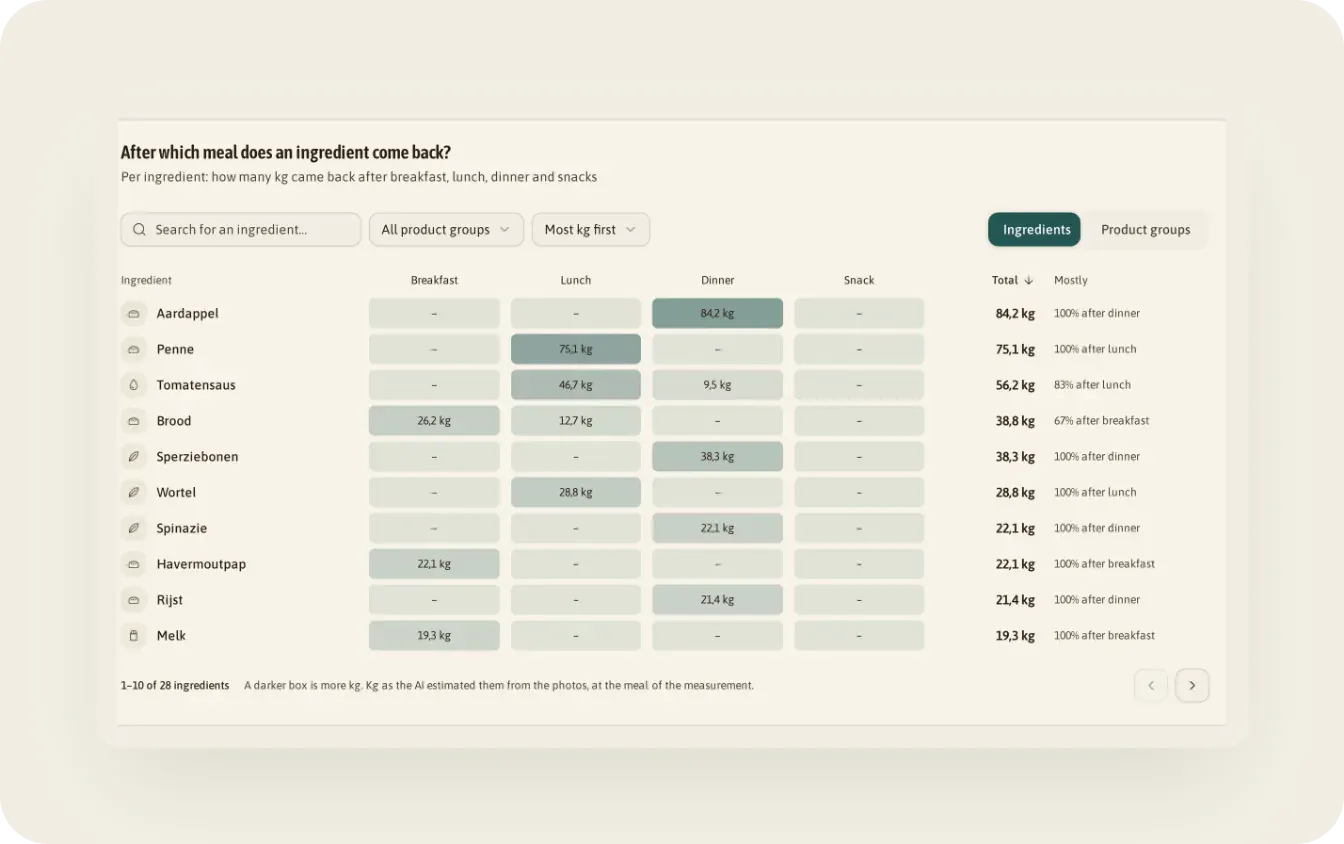
Waste Warrior Monitor follows the approach above. After the meal, staff photograph every plate with leftovers, plus the serving dishes and pans that come back. The AI estimates grams and ingredients per photo, using fixed reference sizes and, when purchases are known, that meal's portion as a guide. Built-in checks cap or flag implausible estimates. Drinks and other leftovers are entered in grams by hand, and they count too.
Staff can correct every estimate per ingredient. The AI's original value is kept next to the correction, so it stays visible what was changed. The app marks the ingredient breakdown as "naar schatting" (estimated), and on the dashboard "Wat ontbreekt" (what's missing) shows which photos failed and how many measurements used an average purchase figure. Image recognition runs on servers in the EU.
Want to see what that looks like with your own meals? Take a look at Waste Warrior Monitor or book a demo.