On paper, food waste in a nursing home looks like the same problem as in a hospital: food goes back to the kitchen. In practice it arises in a different place, for different reasons, and it needs different solutions. Here is what makes Dutch elderly care (VVT: verpleging, verzorging en thuiszorg) different, and how to get a grip on waste without residents losing out.
There are no national figures for nursing homes
Look for figures on food waste in nursing homes and you mostly find figures about hospitals. The best-known one comes from Wageningen University & Research: in hospitals that cooked the traditional way, more than 40% of hot meals went in the bin (WUR, 2016; NOS, 2017). That is about hospital patients. It tells you little about a dementia ward or a small group home for older people.
For nursing homes, no such number exists. In January 2023 the Dutch Minister for Long-term Care wrote: "Er zijn geen cijfers over de hoeveelheid voedselverspilling in zorgcentra", there are no figures on the amount of food waste in care centres (parliamentary answers 2022-2023, no. 1345). The national food waste monitor has no breakdown for care. The Dutch foundation Samen Tegen Voedselverspilling and WUR planned to research this with care organisations, but we have found no published results.
So any percentage you come across for "elderly care" is either an estimate or a hospital figure. The only reliable number for your organisation is the one you measure yourself.
Why waste in nursing homes arises differently
Residents live there
In a hospital, the patients change every week. In a nursing home, people sometimes live for years. Teams know who eats little in the evening and who always asks for a second helping.
That knowledge is valuable, but it usually lives in people's heads rather than in numbers. As a result, the order to the kitchen is rarely adjusted, even when the same food comes back every day.
Dishes and pans in the living room
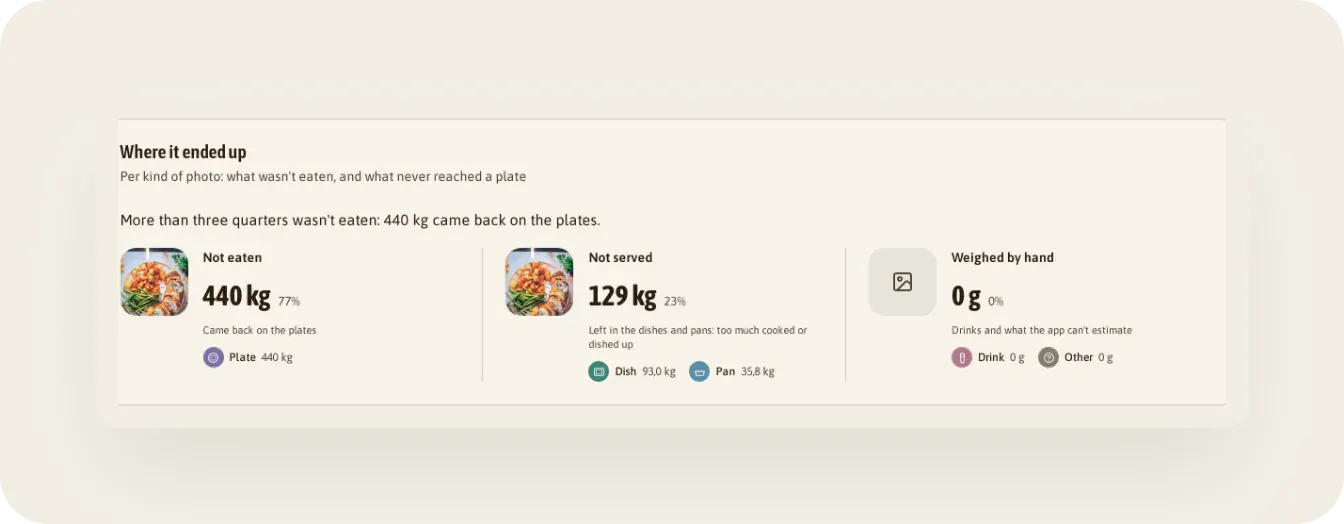
In many Dutch nursing homes, food doesn't reach the ward on pre-portioned plates. It arrives in serving dishes and pans and is dished up in the shared living room. So part of what is left stays on the plate, and part never reaches a plate at all: it stays in the pan.
Those two leftovers tell different stories. What stays on the plate says something about taste, portion size or appetite. What stays in the pan says something about how much is ordered and cooked. Look only at plates and you miss a good part of the picture.
Eating is being together
"Ja, maaltijden zijn zeker een belangrijk sociaal element van de zorg in zorgcentra", the minister wrote in the same answers: meals are certainly an important social element of care. That touches on waste too. A full pan on the table feels hospitable, and nobody wants a resident sitting next to an empty dish.
The reflex is understandable. It does mean that, day after day, more food goes to the ward than is needed.
Small-scale living and cooking on site
In small-scale living, a team often cooks in the living room itself, sometimes with residents. That falls outside the food waste requirement of the Milieuthermometer Zorg, the Dutch environmental certification for care organisations. Requirement 7.3 only applies to central catering: a central kitchen cooking for more than 30 clients, or centrally purchased convenience meals.
The Green Deal Duurzame Zorg, the Dutch care sector's sustainability agreement (version 3.0, succeeded from 1 November 2026 by the 2027-2030 deal "Samen verder"), makes the same distinction. Care providers map their food waste and make every effort to reduce it. "At locations where clients and carers cook for themselves, the focus is on information and awareness" (our translation).
Does your organisation have both settings? Then you measure where food is cooked centrally and build awareness where teams cook themselves. More on the requirement in Milieuthermometer Zorg: how to measure food waste for requirement 7.3, and on the agreement in Green Deal Duurzame Zorg: what it asks about food waste.
Less waste doesn't mean less on the plate
In nursing homes, malnutrition is never far away. In 2024, 16.2% of nursing home residents had (a risk of) malnutrition, almost the same as in 2017, according to the LPZ, the Dutch national prevalence measurement of care problems (Goërtz et al., 2026). That is roughly one in six residents.
A care centre in Delft showed in early 2023 how this can go wrong. According to the newspaper AD, residents received a letter saying portions would be weighed from now on: precisely 150 grams of vegetables and 100 grams of meat. The minister said the letter should not have been sent, and it was corrected in a second letter.
She disapproved of the way the letter had put a budget cut first, and named the better route: "Kleinere porties serveren en extra opscheppen als iemand nog trek heeft", serve smaller portions and give an extra helping if someone is still hungry (parliamentary answers 2022-2023, no. 1345).
That is the heart of it. The goal is the right amount and the right dish for every resident, not less food. What comes back from the ward is waste, but it is also food nobody ate. That is the subject of Plate waste is a care signal: food waste and malnutrition.
What works in the living room
Research specific to nursing homes is thin, but the direction is clear. In 2025 the Dutch National Institute for Public Health and the Environment (RIVM) listed the measures that reduce waste and improve intake at the same time, drawing on experience from hospitals as well as nursing and care homes. Translated to the living room, these are the levers:
- Smaller portions, with second helpings. Start with less on the plate and add more if someone is still hungry. The RIVM found several smaller portions effective against waste, with one caveat: make sure they still deliver enough energy and protein. The minister pointed to exactly this route.
- Dishing up at the table. Where possible, let residents say how much they want, or dish up at the table instead of in the kitchen. The portion then fits that moment's appetite.
- Offering choice. According to the RIVM, more menu choice increases intake and reduces waste.
- Holding some food back in the kitchen. The Coloriet nursing home in Lelystad had its waste measured and found the biggest gains in food coming back from the wards. Their cook: "Better to send too little upstairs than too much. If they give us a quick call, we can always send more" (Zorg voor Beter, 2023, our translation).
- Sharing the menu early. Coloriet makes sure the weekly menu is on the wards a week ahead, so there is time to adjust if residents aren't keen.
- Help at mealtimes. According to the RIVM, actively and personally helping residents with their meal choice works for both intake and waste.
Coloriet added two lessons that apply anywhere. Start small rather than everywhere at once. And bring staff along, so they know why they are doing it.
How to measure food waste in a nursing home
With no national figures, everything starts with your own measurement. MPZ (Milieuplatform Zorgsector), the organisation behind the Milieuthermometer Zorg, advises measuring for at least two weeks at several points: before food goes into the kitchen, during preparation, and in what comes back on the plate. In nursing homes, a few things matter even more.
- Measure per ward or living group. A somatic ward eats differently from a dementia ward. An average for the whole building hides where things go wrong.
- Measure per meal moment. Breakfast, lunch, dinner and snacks each have their own pattern.
- Include serving dishes and pans. In the living room, a large share of the waste is food that was never dished up.
- Record what was purchased. Without knowing what went to the ward, you can't calculate a percentage. The Milieuthermometer measures waste against purchased weight.
- Keep it light for the team. Care staff have little time. A measurement with a lot of paperwork won't last two weeks.
For a step-by-step guide to that first measurement, see Food waste baseline measurement: a step-by-step plan for care. The whole topic in one overview is in Food waste in healthcare: what it costs and how to measure it.
How Waste Warrior Monitor helps in the living room
Waste Warrior Monitor was built for exactly this situation. After the meal, a staff member uses the app to photograph what comes back: every plate with leftovers, and every dish and pan from the living room. Empty plates don't need a photo. The AI estimates how many grams are in each photo and which ingredients they are, and staff can correct every ingredient. Drinks or other leftovers you enter yourself in grams, so everything you throw away is counted.
For each measurement you choose the ward, the meal moment and the number of people. You measure per meal, not per resident. You link purchasing by scanning a delivery note, entering dishes yourself, or through bulk purchase import (CSV import).
The dashboard shows waste as a percentage of purchases, per ward and per meal moment, with the Milieuthermometer levels as an indicator. Waste Warrior does not certify. The dashboard separates what wasn't eaten from what wasn't dished up, so you can see whether to adjust the portion or the order. All data stays in the EU.
Curious what that looks like on your wards? Take a look at Waste Warrior Monitor or book a demo.