If you want silver or gold on the Milieuthermometer Zorg, you have to measure food waste. Requirement 7.3 is only a few sentences long, but every term in it raises questions in the kitchen: what is kitchen waste, what counts as banqueting, and 20% of what? Here is what it says, how to calculate it and how to set up a measurement that stands up at the audit.
What the Milieuthermometer Zorg is
The Milieuthermometer Zorg is the Dutch environmental certification for care organisations and hospitals, set up by the Milieuplatform Zorgsector (MPZ, the sector's environmental platform) together with Stichting Milieukeur (SMK). SMK sets the certification scheme. You certify at bronze, silver or gold.
Version 7 of the certification scheme has applied since 1 January 2025 and runs until 1 January 2028. Food and catering is a theme of its own. Two requirements deal with food waste: 7.1 and 7.3.
Requirement 7.1: a plan with a baseline measurement
Requirement 7.1 is mandatory at every level. Your organisation needs a current plan for sustainable food and catering, with a baseline measurement (nulmeting) and concrete, measurable goals on three topics: the protein transition, reducing food waste and sustainable purchasing.
The plan comes with an action plan setting out measures, priorities, timing and who is responsible. You evaluate that action plan every year, in a way you can show, and adjust it where needed. For silver and gold, the scheme says the plan must align with the goals of the Green Deal Duurzame Zorg 3.0, the Dutch care sector's sustainability agreement. From 1 November 2026 it is succeeded by the 2027-2030 deal "Samen verder", which keeps the same commitment on food waste.
So even if you are aiming for bronze, you need a baseline and a measurable goal for food waste. A goal without a measurement is a wish.
Requirement 7.3: measure food waste, at most 20% of purchases
The core of requirement 7.3 is two sentences. Literally (MPZ, our translation):
"At least once a year, food waste from kitchen waste, plate waste and banqueting is measured and recorded. Food waste is at most 20% of purchased weight within 2 years of certification."
Based on the results, you also draw up an action plan to reduce waste and include it under requirement 7.1. Measurement and plan belong together.
For silver and gold, 7.3 is mandatory, and falling short counts as a major nonconformity. For bronze it is an extra requirement: not compulsory, but it counts towards the number of extra requirements you need. So at bronze you are not obliged to get below 20%. If you do count 7.3 as an extra requirement, you have to meet it.
Kitchen waste, plate waste and banqueting
The requirement names three streams. Only banqueting is defined by MPZ, in the glossary on the requirement page. For the other two, we use the following working definitions, which hold up well in practice:
- Kitchen waste (keukenafval). What is left in the kitchen: overproduction, leftovers in pans and trays, and products that pass their date.
- Plate waste (bordenafval). What comes back from the ward: leftovers on plates, and food left in serving dishes or returned untouched.
- Banqueting. According to MPZ, "providing food and drink at events and meetings within the care organisation". Think of lunch at a meeting, a reception or a staff event.
Write down in your plan what you count under which stream. Other definitions are fine, as long as you apply them the same way every time. Only then can the second measurement be compared with the first.
Gold: at most 15% for prepared meals
For gold there is a second limit: "Food waste from prepared meals is at most 15% relative to weight within 2 years of certification."
Watch the base. The 20% is relative to purchased weight, the 15% to the weight of prepared meals. The scheme doesn't spell out how to define that weight. Agree the definition with your certification body before you start measuring, and put it in your plan.
Which sites does requirement 7.3 apply to?
The requirement applies to central catering: a central kitchen cooking for more than 30 clients, or centrally purchased convenience meals. Care with decentralised food provision falls outside it, such as a residential group where clients and carers cook for themselves.
Many organisations have both. For 7.3 you then measure the streams that come from the central kitchen or central purchasing.
How to calculate 20% of purchases
The sum is simple: the weight you throw away, divided by the weight you buy, over the same period.
Waste (%) = weight thrown away ÷ weight purchased × 100
An example. Say the central kitchen buys 4,000 kg in two weeks. Over those same weeks you measure 520 kg of kitchen waste, 260 kg of plate waste and 40 kg of leftovers from meetings. That makes 820 kg. Divided by 4,000 kg, it comes to 20.5%: just above the silver limit.
Whether that percentage survives an audit depends on three things:
- The same period. Use the purchases from exactly the weeks you measure. Otherwise a large delivery for stock distorts the picture.
- The same scope. If you only measure the central kitchen, only count that kitchen's purchases.
- Real purchase data. The hardest part is often not the waste but the purchases, spread across delivery notes and invoices from different suppliers. Agree in advance who collects them.
How your kitchen works determines where waste arises. In hospitals where meals were still portioned, WUR found that nearly half of the waste arose at portioning (WUR, 2016). Switch to a different meal concept and what you measure shifts too. Note such a change, so your figures stay comparable.
How long and how often to measure
The requirement asks for at least one measurement a year, but doesn't say how long it should last. In its themed dossier, MPZ advises at least two weeks, at different points in the process: before food enters the kitchen, in the kitchen and on the plate.
Treat two weeks as the floor. It captures a normal period, with the differences between days and meals. Pick weeks without bank holidays or a menu change.
You can always measure more often. Continuous measurement isn't required, but it shows sooner whether a measure works, and you don't have to wait a year to adjust. How to set up a first measurement is covered in Food waste baseline measurement: a step-by-step plan for care.
What the auditor checks
For 7.3 the inspection method is an administrative check of the goals in your sustainable food and catering plan. So the auditor looks at the plan and the goals in it. It is sensible to have your measurement data, your calculation and your action plan ready as well, so you can show what your goals are based on.
You don't have to reach 20% on the day you are certified, but within two years after. A measurement at the start and a repeat later show which way things are going.
Checklist for requirements 7.1 and 7.3
- You know whether you have central catering (more than 30 clients or centrally purchased meals).
- You have written down what you count as kitchen waste, plate waste and banqueting.
- You have a baseline measurement of at least two weeks.
- You have the purchased weight for the same period.
- You have calculated the percentage, and for gold also the one for prepared meals, using a base agreed with your certification body.
- Your sustainable food and catering plan contains a measurable goal for food waste.
- There is an action plan with measures, priorities, timing and responsibilities.
- You evaluate the action plan every year and measure again at least once a year.
How this fits into the wider story of cost, climate and malnutrition is covered in Food waste in healthcare: what it costs and how to measure it. What the Green Deal asks is in Green Deal Duurzame Zorg: what it asks about food waste.
How Waste Warrior Monitor helps with requirement 7.3
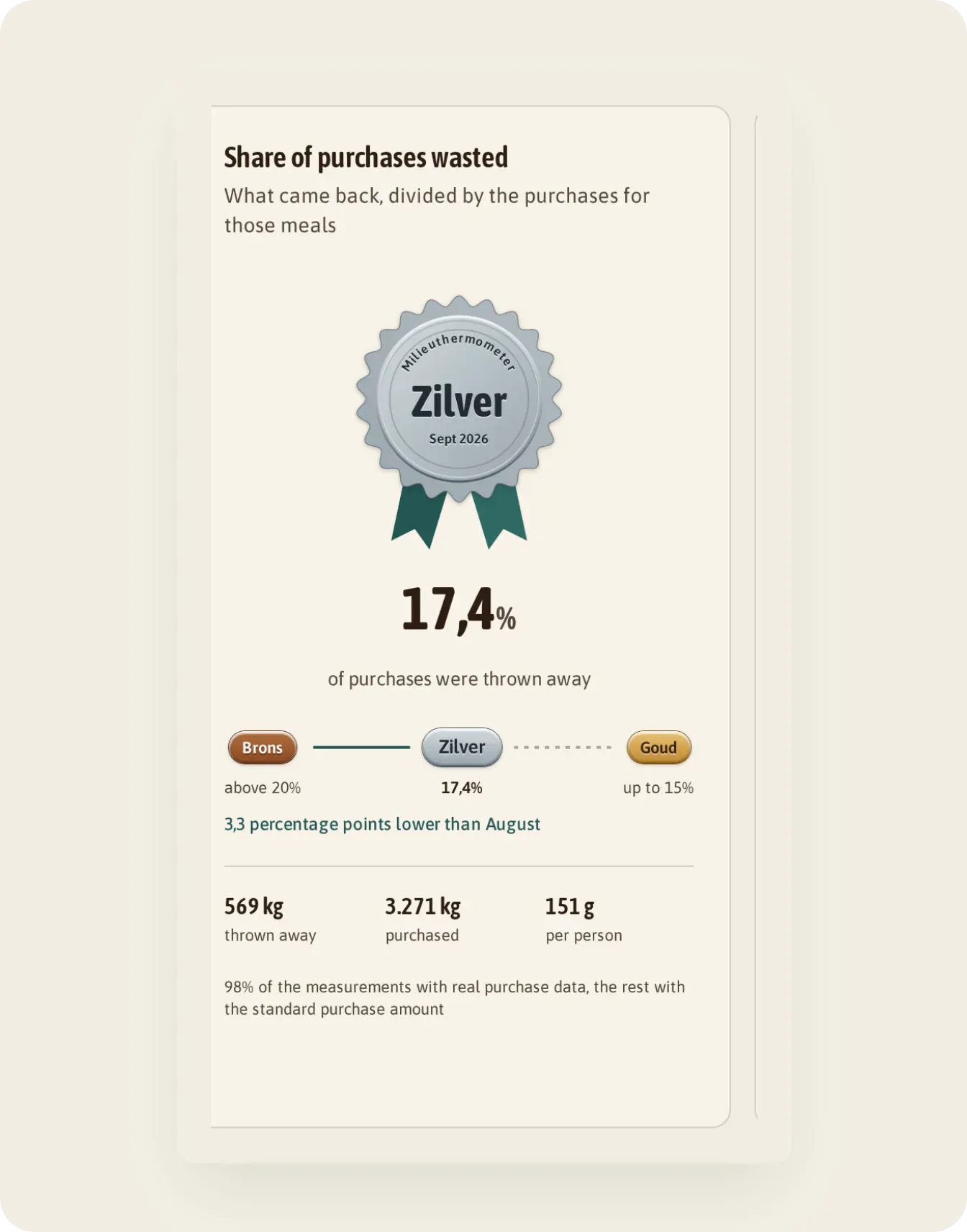
Waste Warrior Monitor uses the same measure as the Milieuthermometer: what you throw away as a percentage of purchases. Staff photograph what comes back with the app. The AI estimates the weight and ingredients in each photo, and staff can correct every ingredient. Plates and serving dishes count as plate waste, pans as kitchen waste. What the AI doesn't estimate, such as drinks or leftovers from a meeting, you record with a weight you estimate and enter yourself. That way everything counts.
You link purchases by scanning a delivery note or with bulk purchase import (CSV import), for example from your supplier's export. The dashboard shows the percentage per period, per meal and per ward, with an indicator for bronze, silver and gold. That indicator is not a certification: it shows how far you are from 20% and 15%. "Wat ontbreekt" (what's missing) shows which meals or wards haven't been measured yet, so you know whether your figures are complete. Automatic report generation (PDF report) puts the figures on record for your file.
Curious how that works for your site? Take a look at Waste Warrior Monitor or book a demo. More answers are in the FAQ.