
A table for four is laid. The guests don't come, and they don't call. The seats stay empty, but in the kitchen the mise en place for those four is already prepped. For almost every restaurant, no-shows are a recurring annoyance. Some big numbers circulate about how often they happen and what they cost. This article covers what has actually been measured, where the big numbers come from, and what demonstrably helps.
How often do guests really not show up?
Less often than you might think, if you look at measurements. And more often than you'd like, if you ask owners.
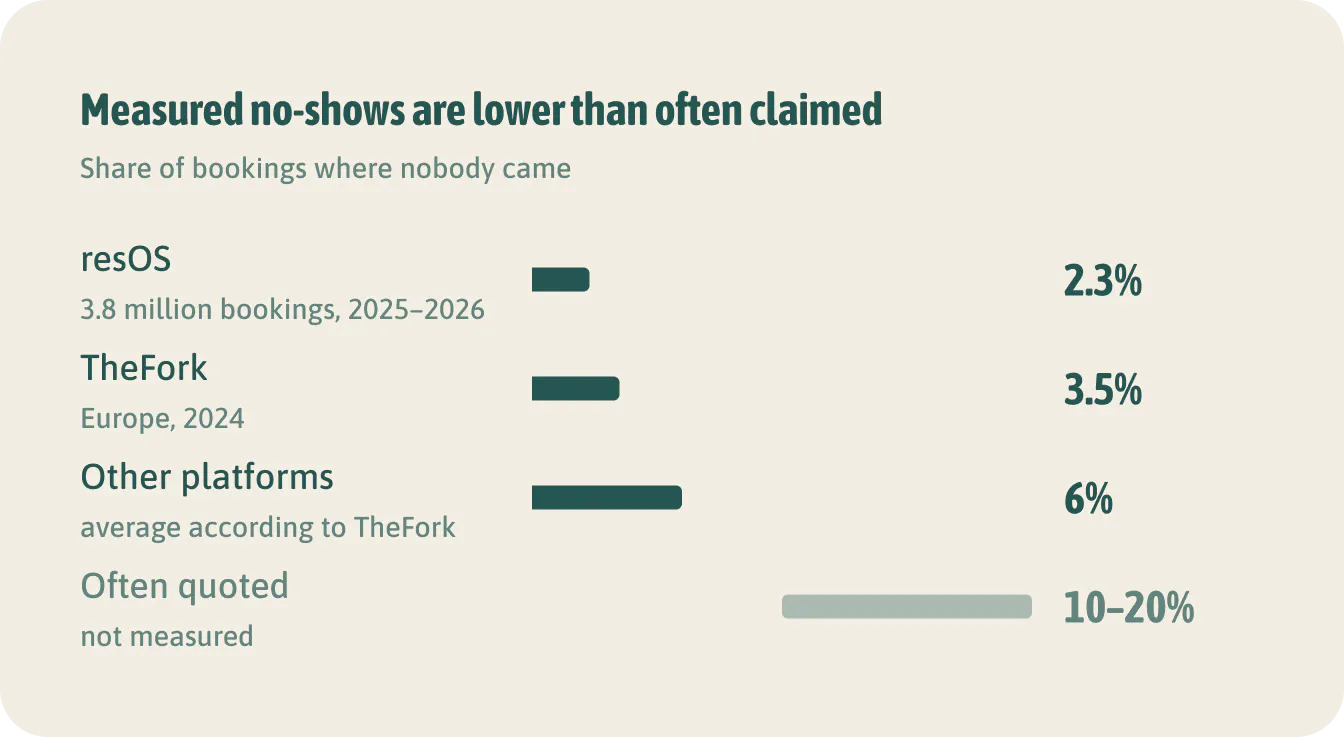
Measured rates. The best measured data come from booking systems themselves. resOS analysed almost 3.8 million bookings at 2,417 restaurants from August 2025 to July 2026. On average, 2.3% of bookings were no-shows. By country, the rate ranged from 0.5% in Switzerland to 5.9% in France (resOS, 2026). There was no figure for the Netherlands. TheFork reported 3.5% for Europe in 2024, up from 3.2% in 2023, and an average of 6% on other platforms (TheFork, 2024).
This is vendor data. The restaurants selected themselves, and only no-shows that staff recorded are counted. So the true figure is probably a little higher. Still, the order of magnitude is clear: on average 1 to 6% of bookings. For a single restaurant it can be a lot higher, for example on busy holidays or with large groups.
What owners experience. In a survey of 250 Dutch hospitality owners, 88% said they deal with no-shows at least once a month. For 31% it happens several times a week (Lightspeed and Zenchef, 2024, n = 250). That's a survey of owners. It measures how often no-shows occur, not what share of bookings they make up. So both pictures are true at once: no-shows are rare per booking, but they happen almost everywhere.
Guests who book online are somewhat more likely to stay away than those who phone. According to KHN, the Dutch hospitality association, anonymity lowers the threshold (KHN, 2019). That's a 2019 poll, but many owners will recognise the mechanism.
Where the 10 to 20% and the billions come from
You often read that 10 to 20% of guests don't show up, or that no-shows cost UK hospitality £16 billion a year. These numbers didn't come from nowhere, but they weren't measured either.
The 20%. A widely cited economics paper on reservations mentions a no-show rate of 3 to 15% at one restaurant studied. It adds that 20% is "not unusual" and that New Year's Eve can push it to 40% (Alexandrov and Lariviere, 2012). Those last two figures come from newspaper articles from 2001 and 2003, not from data. They have been repeated many times since.
The billions. The £16 billion figure appeared during a campaign by UK chefs in 2020 and 2021. No source or calculation was ever given (Code Hospitality, 2021). A later figure of £17.6 billion comes from a point-of-sale vendor, and is an estimate of lost sales based on a consumer survey (Zonal). Lost sales are not lost profit, and the method hasn't been published.
That doesn't mean no-shows aren't a problem. It means you're better off working with your own figures than with numbers that do the rounds.
What a no-show costs: revenue and food
A no-show costs you in two ways. The seat stays empty, and the kitchen has already bought and prepped for it.
Revenue. If you can't fill the table again, you lose that evening's revenue. UK restaurants put the loss at an average of £55.70 per two-person table (OpenTable, 2026). In the Dutch survey, 28% of owners named lost income as the biggest damage (Lightspeed and Zenchef, 2024).
Food. In the same UK research, 48% of operators named wasted provisions as a result of no-shows (OpenTable, 2026). That makes sense. The kitchen preps for the number of guests booked. Whatever is ready for an empty seat often can't go back.
An example from the Netherlands: at the in-house restaurant of the province of Zuid-Holland, about a quarter of the guests who signed up didn't come. By tackling that, the province expected to save around €5,800 on discarded meals (Provincie Zuid-Holland, 2020). That's a staff restaurant rather than a regular restaurant, but the link is the same.
Here's a worked example for your own business, with assumptions you fill in yourself. Say you serve 300 covers a week and 3% don't show up. That's 9 empty seats a week. At €45 per guest, that's €405 of revenue a week you won't get back, if you don't resell the seat. If you count 150 g of mise en place per cover, there's also 1.35 kg of food ready each week for guests who don't come. It's a calculation, not a measurement. Check it with your own figures.
Reminders: the best-studied tool
A lot is known about reminders, mostly from healthcare. Missed appointments have been a cost there for decades, and they've been studied well.
- Text reminders. A Cochrane review, the gold standard in healthcare research, found that a text reminder increases attendance. Without a reminder, 67.8% attended; with a text, 78.6%; with a phone call, 80.3%. A text worked almost as well as a call and was much cheaper (Cochrane, 2013).
- A third fewer on average. A review of 29 studies found that phone and text reminders cut missed appointments by an average of 34%. Automated messages worked a little less well than a personal phone call. Whether the reminder came a day or a week ahead made no difference (Hasvold and Wootton, 2011).
- WhatsApp. A large study in the public health system of Buenos Aires found that a single WhatsApp reminder 24 hours ahead cut no-shows by about a quarter. A second reminder added nothing (Esteban et al., 2026). This is a preprint that hasn't been peer-reviewed yet.
- Email. Email reminders also lower missed appointments, a bit more modestly (Santillan and Giunta, 2026).
All these studies are about healthcare, not restaurants. A doctor's appointment is different from a dinner out. But the mechanism is the same: people forget, or don't cancel because it takes effort. A message at the right moment helps with both.
There are restaurant figures too. Bookings that received an SMS reminder had a 16% lower no-show rate (resOS, 2026). The authors point out that this is an association, not proven cause and effect. And UK operators named a confirmation reminder as the most effective tool, ahead of cancellation windows and deposits (OpenTable, 2026).
In the Netherlands, 83% of venues already send a reminder email, and 10% call the day before (Lightspeed and Zenchef, 2024). So a reminder won't surprise your guest. The difference lies in how personal it is, and how easily the guest can act on it.
Deposits and strict rules: they work, but at a price
A deposit or card guarantee is the obvious option. KHN lists it among its tips against no-shows, alongside limiting bookings, confirming, making cancelling easy and overbooking (KHN). Under the standard Dutch hospitality terms (Uniforme Voorwaarden Horeca), you may charge the full value of the booking.
It works, too. Bookings with a guarantee or deposit had a no-show rate of 0.8%, against 2.5% without (resOS, 2026). Again the authors add a warning: restaurants that ask for a deposit differ from those that don't in more ways than one.
There's a downside. In three experiments, researchers found that strict cancellation policies and an awkward way of cancelling lower people's intention to stay away. But they also make guests less willing to book. The researchers recommend lenient policies combined with easy cancelling and a message that makes guests aware of what a no-show does (Kim et al., 2025). These experiments measured intentions, not actual behaviour.
In the Netherlands, 16% of venues ask for a deposit (Lightspeed and Zenchef, 2024). Whether it suits you depends on your guests and your concept. A Michelin-starred restaurant on a Saturday is a different story from a neighbourhood bistro on a Tuesday.
Making cancelling easy
A guest who cancels in time isn't a no-show. You can resell the table, and the kitchen preps less. So it pays to make cancelling as easy as possible.
That means three things.
- One tap, no phone call. A guest who has to call will put it off. A link in a message they already have works better.
- At the right moment. A reminder a day ahead gives the guest time to cancel, and you time to fill the table.
- Through a channel they read. WhatsApp has 13.7 million users in the Netherlands (Newcom, via NOS, 2025). Your guest doesn't need to install anything.
We don't make claims about open rates for WhatsApp or email. The often-quoted 98% for WhatsApp is an old SMS figure from 2010, and its original source has withdrawn it. What has been shown is that a reminder by message increases attendance.
Menu choice in advance and no-shows
A guest who picks their dishes in advance is already looking forward to the evening. The personal message turns a booking into a commitment, and guests who feel involved show up. We saw that in the pilot at restaurant Bij Bram in Utrecht. There, 40% of guests with a booking gave their menu choice in advance. None of those guests failed to show, and visibly less food was thrown away (KHN, April 10, 2026, in Dutch).
So every guest who chooses in advance is a guest who comes. If 40% of your guests choose, that removes around 40% of your no-shows, and probably more. The message also works as a reminder for the rest of the table, and reminders have been shown to increase attendance. If a guest can't make it after all, they cancel through the same link, and you hear about it sooner.
That makes menu choice in advance a friendly form of commitment, without a deposit. Why asking in advance also helps against waste is covered in Menu choice in advance: why asking beats guessing.
How Waste Warrior helps with no-shows
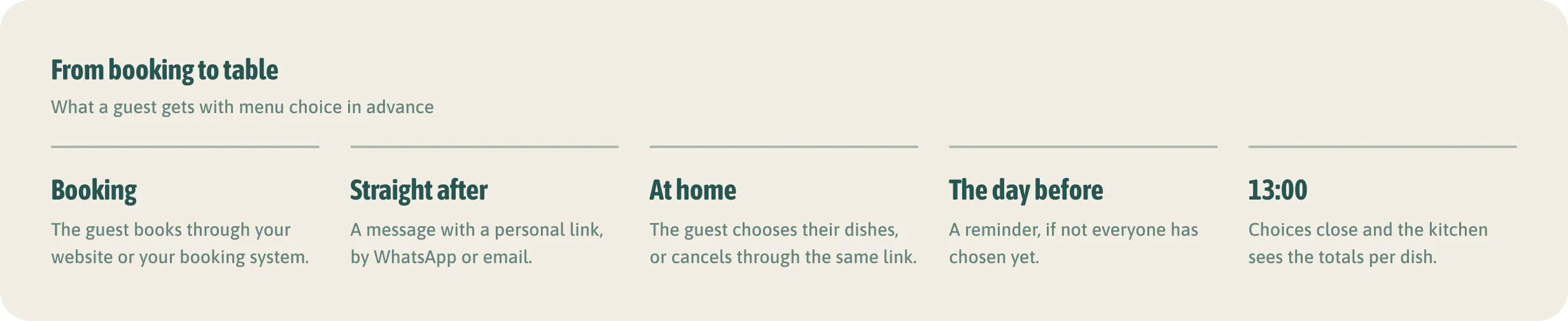
Waste Warrior sends every guest with a booking a personal message, by WhatsApp or email. It contains a link to their own page, where the guest picks a dish in advance. They share the link with the rest of the table, so everyone gives their own choice, with no app or account. If not everyone has chosen and the booking is more than a day away, a reminder follows the day before.
On the same page, a guest can let you know they can't come after all. Guests who book through the booking button on your own website get a confirmation with a link to change the date, time or party size themselves, or cancel the booking. If you use your own booking system, bookings come into Waste Warrior automatically, and so do changes and cancellations. You don't need to set anything up; Waste Warrior makes the connection. More in Connecting your booking system to Waste Warrior.
Your kitchen sees on the day itself how many of each dish are coming. Choices close at 13:00 on the day by default; you can change that time. As an extra nudge, you can offer a discount per response. Whether you do, and how much, is up to you. Messages go by email and WhatsApp. The system isn't tied to one channel, so we can add another on request, such as Signal.
Worth knowing: it stays a preference, not an order. A guest doesn't commit to anything by choosing, and Waste Warrior doesn't handle deposits or payments. How to set it up is in Setting up reservations with menu choice in advance, step by step. Short answers are in the FAQ on messages to guests. The bigger picture is in Food waste in hospitality: the complete guide.
Curious how that would work in your restaurant? Take a look at menu choice in advance or plan a demo.