
Every day a restaurant throws away food that was bought, chopped and sometimes already cooked. Most of it goes unnoticed. It disappears into a bin, and at the end of the month all you see is a high food bill. This guide sets out how much the hospitality sector wastes, where it happens and why. Then it covers what works: measuring, asking guests in advance what they'll eat, cutting no-shows, and handling events and dietary needs more cleverly. It ends with a plan to get started.
How much food does hospitality waste?
The short answer: a lot, but exactly how much depends on who you ask. There are several sources, and they don't measure the same thing.
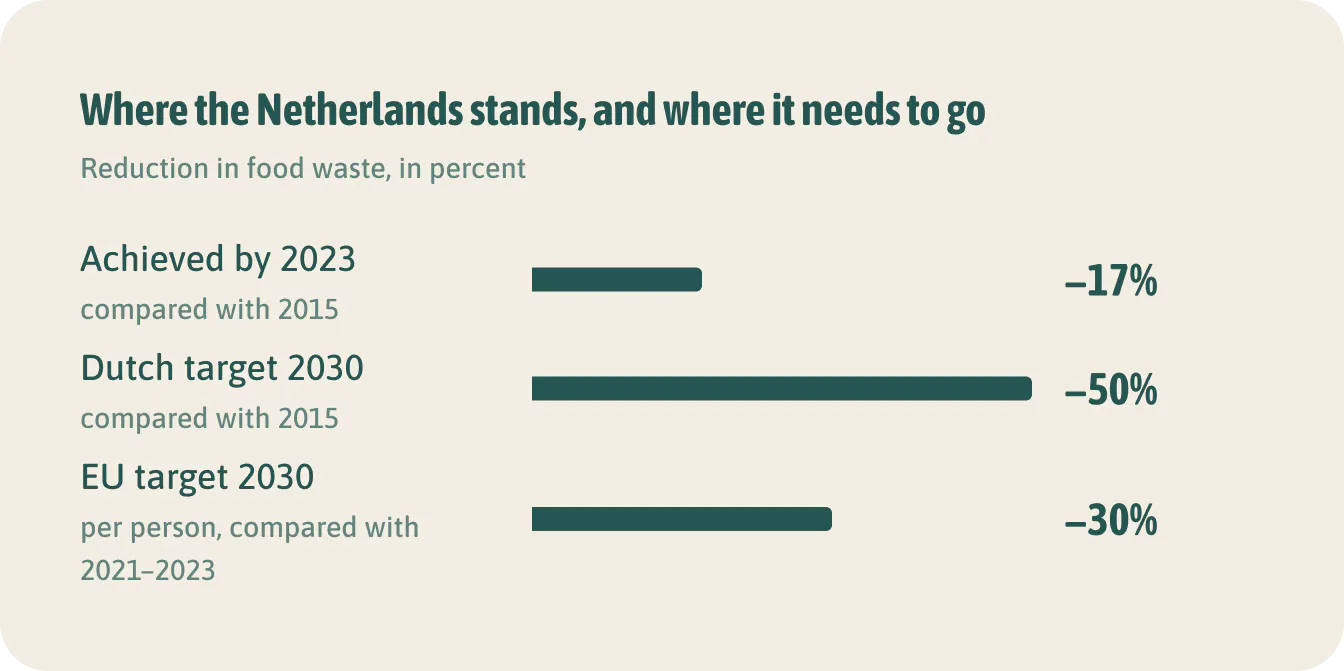
The national monitor. In 2023 the Netherlands wasted 2,271 kilotonnes of food in total, or 127 kg per person. That's 17% less than in 2015 (WUR, 2025). Of that total, 83 kilotonnes came from restaurants and catering services, about 4%. That looks small. Wageningen University & Research (WUR), which runs the monitor, notes that the figure covers restaurants only, which account for about 40% of food and drink sales in Dutch hospitality. The real share for the whole sector is higher.
The bank. According to Rabobank, Dutch hotels, cafés and restaurants together waste more than 55 million kg a year, worth €647 million (2023 figures). That is an estimate based on measurements in the Food Waste Challenges, using a different method from WUR's.
Don't put those two numbers side by side. They have a different scope and a different method, so the gap between them doesn't mean one of them is wrong. Use one source per claim, and name it.
Worldwide. In 2022 the world wasted 1.05 billion tons of food. Restaurants, canteens and other food service accounted for 28% of it, an average of 36 kg per person per year (UNEP, 2024). Households waste more, but per meal, food service is no small player.
Per plate. For a kitchen, a figure per portion is more useful. In a study with data from 1,189 kitchens in Sweden, Norway, Finland and Germany, restaurants wasted an average of 190 g per portion. Canteens came to 50 g (Malefors, SLU, 2021). Across the whole catering sector, about a fifth of the food served was wasted.
What that means for your business, you work out with your own figures. There's a worked example in Measuring food waste in restaurants: what it costs and where to start.
Where the food goes: from fridge to plate
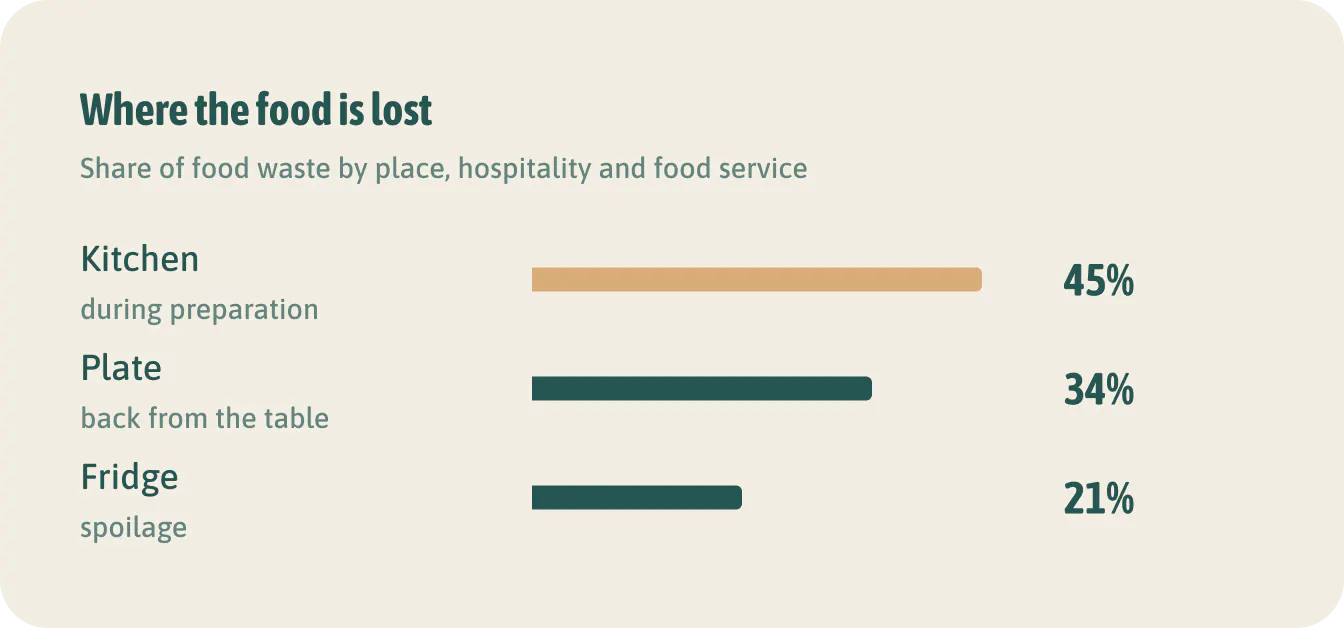
Plate waste is what you notice. It comes back on a tray and everyone front of house sees it. Yet in a restaurant, most waste arises earlier on. UK figures from WRAP (2013) show how it was split in hospitality and food service:
- Preparation. 45% arose in the kitchen: trimmings, failed or leftover mise en place, food that was cooked but never served.
- Plate. 34% came back from the table.
- Spoilage. 21% was lost in the fridge and the stockroom.
WRAP also found that 75% of that waste could have been eaten. It was the equivalent of one in six meals served. These are older figures from another country, so use them as a direction, not a standard. Many chefs will recognise the picture, though.
That's why measuring means tracking three streams: fridge waste, kitchen waste and plate waste. If you only look at plates, you miss most of it.
Why kitchens cook too much
Waste in a restaurant is rarely carelessness. Usually it's a sensible response to uncertainty. You don't know exactly how many guests will come, or what they'll order. Nobody wants to tell a guest a dish has sold out. So you make a bit extra.
Guessing guest numbers
The study by Malefors (SLU, 2021) is clear on this. The biggest risk factor for waste was the amount of food prepared relative to the number of guests who actually came. Malefors calls it a problem kitchens can tackle by forecasting. In schools, where food was cooked for every enrolled pupil, the estimate was off by 20 to 40% on average. With the best forecasting models, that came down to 2 to 3%. There is a caveat: a forecast can come in too low, so always keep some margin.
The menu
A long menu means a lot of different mise en place. Every dish needs its own prepared components, and you make a little extra of each to be safe. The more dishes, the more small buffers end up in the bin together. A dish that sells poorly costs relatively a lot.
Portions
What comes back on the plate often says something about the portion. If a popular dish regularly comes back half eaten, the portion is probably too big, or a side isn't being eaten. You only see that when you look per dish.
No-shows
A guest who doesn't turn up leaves an empty seat. But the kitchen has already bought and prepared for that seat. In a survey of UK restaurant operators, 48% named wasted provisions as a result of no-shows (OpenTable, 2026).
How often it happens is less dramatic when you look at measurements. Across 3.8 million European bookings, an average of 2.3% of guests didn't show up (resOS, 2026). At TheFork the figure was 3.5% in 2024, and other platforms averaged 6% (TheFork, 2024). That's lower than the 10 to 20% you often hear. Even so, 88% of Dutch hospitality owners deal with no-shows at least once a month (Lightspeed and Zenchef, 2024, n = 250). Where the higher percentages come from and what really helps is covered in No-shows in restaurants: what they really cost and what helps.
Measuring: know where the food goes
You can only waste less on purpose once you know what goes in the bin. That sounds obvious, but hardly any restaurant knows exactly. Practice shows that measuring has an effect in itself.
- Food Waste Challenge Friesland. Ten Dutch restaurants measured and adjusted for eight weeks. On average they cut their waste by 15% (KHN, 2023).
- Champions 12.3. In an analysis of 114 restaurants in 12 countries, kitchen waste fell by an average of 26% in the first year. Every dollar invested returned an average of 7 dollars (Champions 12.3, 2019).
- Hotels. At breakfast buffets, an average of 62.2 g of food per guest was left over, measured across 24 Dutch hotels (Hotelmonitor STV and WUR, via KHN). A figure per guest like that gives you a yardstick for your own business.
These are averages from supported programmes, not a guarantee for your business. But the pattern is always the same: when you measure, you see where the food goes, and when you see that, you start doing things differently.
Measuring doesn't have to be complicated. Separate the three streams, record them at fixed times, weigh once a day and link plate waste to dishes. The six-step setup is in Measuring food waste in restaurants: what it costs and where to start. Which method suits you, from scales to a photo per plate, is in Measuring food waste: scales, bin camera or a photo per plate? And how to start with Waste Warrior Monitor is in Getting started with measuring: your first two weeks with Monitor.
Predicting: ask your guests
Measuring tells you what went wrong yesterday. To cook less tomorrow, you need to know what's coming tomorrow. There are two ways: forecast from your data, or ask your guests.
Forecasting works. In a controlled trial in school kitchens, food that was prepared but not served fell by 34 g per portion when kitchens started forecasting how many would come. In the comparison group it was 11 g (Malefors et al., 2022). But a restaurant isn't a school. Your bookings tell you how many people are coming. What they'll eat, you don't know.
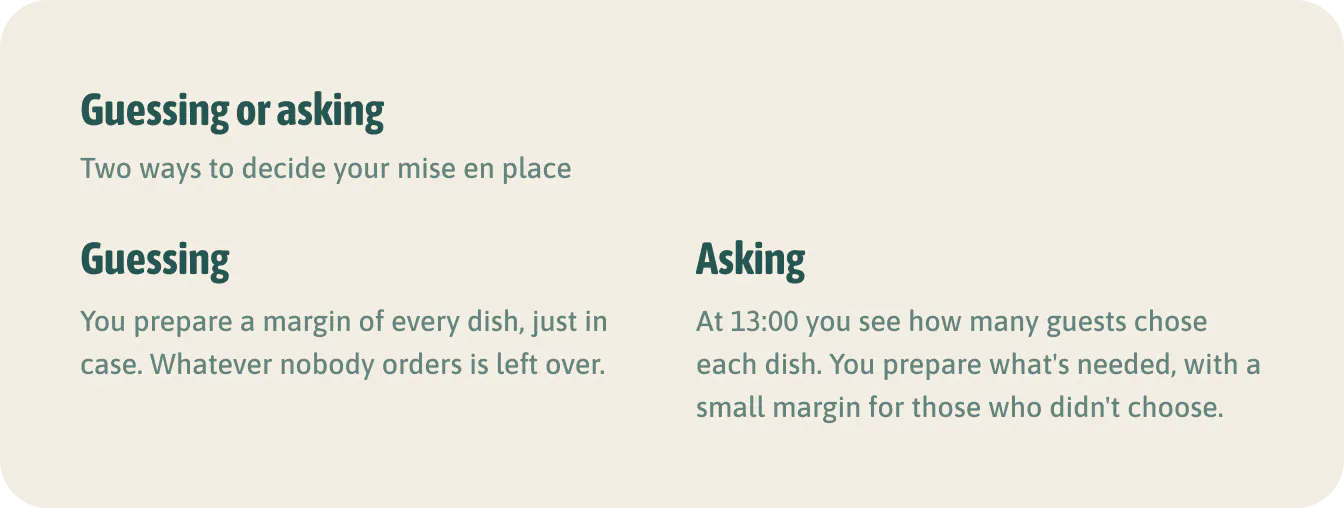
That's the idea behind menu choice in advance. When you guess, you cook extra to be safe. When you ask, you don't have to guess. A guest who has booked gets a message with a link and picks a dish at home. On the day itself, the kitchen sees how many of each dish are coming.
Two things make the difference.
- A preference, not an order. In a university canteen with mandatory pre-orders, some orders were never collected. That is exactly the waste you were trying to avoid (Migliavada et al., 2021). So leave the guest free to change their mind at the table.
- Timing. The closer the choice is to the meal, the better it fits. In an Australian hospital, plate waste fell from 29% to 12% when patients ordered just before eating instead of well in advance (McCray et al., 2018). A hospital is not a restaurant, but the mechanism is the same.
To be fair: no independent study has yet measured the effect of menu choice in advance in restaurants. In a pilot at restaurant Bij Bram in Utrecht, 40% of guests with a booking chose their dish in advance (KHN, April 10, 2026, in Dutch). Visibly less food was thrown away, but it's one pilot without a control group. The research, its limits and what it means for your mise en place are in Menu choice in advance: why asking beats guessing.
Events and catering: when the numbers seem known
At an event you know how many guests are coming, surely? Not always. And even when the count is right, a lot is left over.
- Meeting lunches. At 391 lunch meetings in the Netherlands, 22% of what was served was left over, mostly sandwiches and wraps. At coffee meetings it was 42% (STV, Veneca and WUR, 2024).
- Hotel functions. At events and functions in Irish hotels, an average of 530 g of food per guest was wasted, from preparation to plate. Ireland's environmental agency notes that this happens even though guest numbers are usually known (EPA Ireland, 2022).
- Conferences. At six business conferences in the US, an average of 42% of prepared food went uneaten (U.S. Food Waste Pact, 2026).
The causes look like those in a restaurant. For its own meeting lunches, the Dutch province of Zuid-Holland mainly named oversized portions and no-shows (Provincie Zuid-Holland, 2020). Free events also see a larger share of registrants not turning up than paid events, according to a software vendor's own data (PheedLoop, 2026).
Guidelines for sustainable events give familiar advice. Have guests register and give their dietary needs in advance, so the caterer has an accurate count. Prefer plated service at the table to a buffet (WMA, 2022). Share attendance data, such as no-shows, with the kitchen. And don't overproduce special meals (U.S. Food Waste Pact, 2026).
More on where it goes wrong at events is in Food waste at events and catering: where it goes wrong. How to set up an event with a guest list and menu choice is in Organising an event with a guest list and menu choice in advance.
Allergens and dietary needs
Dietary needs affect waste in two ways. A vegetarian or gluten-free meal nobody announced gets made at the last minute. And to be safe, you make a few extra of every special version. At events, that's a known source of overproduction.
The question comes up a lot. About one in eight Europeans say they currently have a food allergy, though fewer than 1% are confirmed by a food challenge test (Spolidoro et al., 2023). In the Netherlands, a quarter of all main meals in 2023 were vegetarian (CBS, 2024).
There's also a legal duty. For food that isn't prepacked, including in restaurants and catering, you must be able to tell guests which of the 14 EU allergens it contains (Regulation (EU) 1169/2011). In the Netherlands you may tell them in person, but the information must also be available on paper or digitally (NVWA). In 2023 inspections, more than half of the businesses checked by the Dutch food safety authority fell short (NVWA, via Hart van Nederland).
Ask for dietary needs in advance and you win twice. The kitchen knows what's needed, and the guest doesn't have to explain it again at the table. Do keep in mind that an allergy is health data, and stricter privacy rules apply to it. More on that in Allergens and dietary needs in hospitality: rules and practice and Guest data and the GDPR for reservations and events.
What the EU asks for 2030
Restaurants have no legal duty to measure food waste. There are targets, though. The Netherlands aims to halve food waste by 2030 compared with 2015 (Dutch government, 2025).
Since 2025 the EU has also set binding targets in Directive (EU) 2025/1892. By 2030, waste at retail and consumption, meaning restaurants, food services and households together, must be 30% lower per person than the 2021 to 2023 average. For processing and manufacturing the target is 10%.
Those targets apply to member states, not to your kitchen. Still, they make it likely that food waste in hospitality will get more attention, from governments, from trade bodies and from business clients. If you measure now, you'll have your own baseline later and won't need to reconstruct it.
A plan in five steps
You don't have to do everything at once. Start small and build from there.
- Measure for two to four weeks. Separate fridge waste, kitchen waste and plate waste, and weigh once a day. Include busy and quiet days. That gives you a baseline.
- Find the biggest item. If a lot goes in the fridge, look at your purchasing. Lots of trimmings and leftover mise en place point to prepping without knowing what's coming. Lots of plate waste on one dish points to the portion.
- Ask what you can ask. Let guests with a booking give their dish and dietary needs in advance. For events, also ask whether they're coming. A guess becomes a list.
- Cut no-shows. Send a personal reminder and make cancelling easy. A guest who cancels in time saves you a seat and a portion.
- Change one thing at a time and keep measuring. Then you'll see what works. Spend five minutes a week going over the figures with your team.
The pattern is the same as in healthcare: measure first, then change the system. How to get from figures to measures is in Reducing food waste in care: what do you do with the figures? It's written for care, but the approach works in any kitchen. Short answers to common questions are in the FAQ on menu choice in advance.
How Waste Warrior helps your kitchen: reservations, events and Monitor
Waste Warrior has three parts that fit together: asking in advance for reservations, asking in advance for events, and measuring what goes in the bin.
Reservations with menu choice in advance. A guest books through your own booking system or the button on your website. If you use your own booking system, new, changed and cancelled bookings come in automatically. You don't need to set anything up; Waste Warrior makes the connection. How that works is in Connecting your booking system to Waste Warrior. The guest gets a WhatsApp message or email with a personal link and shares it with the rest of the table. Everyone picks a dish on their own phone, with no app or account, and can add a comment, such as an allergy. If not everyone has chosen, a reminder follows the day before. It's a preference, not an order. Choices close at 13:00 on the day itself by default; you can change that time. Your kitchen sees under "Kitchen" and "Totals" how many of each dish are coming, with the comments alongside. How to set it up is in Setting up reservations with menu choice in advance, step by step.
Events. You put your guests on a list, by hand, from a CSV file or through a sign-up link. For each phase you plan an invitation and reminders, by email, WhatsApp or both. Every guest gets their own page to say whether they're coming and what they'd like to eat. If you allow it, they can add someone themselves. Until the deadline, a guest can change their choice or cancel. The kitchen sees the totals per dish for each event, with guests' comments.
Waste Warrior Monitor, restaurant version. During the day your team photographs what's thrown away and marks each photo as kitchen waste, fridge waste or plate waste. A plate photo can be linked to a dish on your menu. The AI estimates grams and ingredients per photo, and once a day you weigh the bins. The dashboard shows, per day and per week, where the food goes, which ingredients are thrown away most and which dishes often come back, with labels such as "popular and lots left over: portion too big?".
For reservations and events, messages go by email and WhatsApp. The messaging system isn't tied to one channel, so we can add another on request, such as Signal. There's no fixed price. You start with a pilot at one location, with no hardware and no long contract.
Curious how that would work in your business? Take a look at menu choice in advance, events or Waste Warrior Monitor, or plan a demo.