
Every afternoon, a kitchen makes a guess. How many guests are coming tonight, and what will they order? Guess too low and you have to tell guests a dish has sold out. So you guess a little high. Part of that margin, per dish and per day, ends up in the bin. When you guess, you cook extra to be safe. When you ask, you don't have to guess. This article covers what research says about knowing in advance what's coming, why a choice should stay a preference, what it means for your mise en place and purchasing, and what we don't know yet.
Why a kitchen guesses
A restaurant that takes bookings knows roughly how many guests are coming. What they'll eat, it doesn't know. And that's exactly what decides how much mise en place you need.
Take a menu with four mains. For each dish you prep components: a sauce, a garnish, chopped vegetables, a piece of meat or fish already portioned. You don't know how orders will be spread across the four dishes. So you make enough of each for a busy night. If the choices fall differently, there's plenty left of one dish while another runs out.
That isn't carelessness. It's a sensible response to uncertainty. Disappointing a guest has a cost too. But the result is that almost every day, food gets prepared that nobody eats.
How much varies by business. In a large study with data from 1,189 kitchens, restaurants wasted an average of 190 g per portion, against 50 g in canteens (Malefors, SLU, 2021). Restaurants have more choice on the menu and less sight of what will be ordered. That isn't the only reason for the gap, but it fits the picture.
What research says about knowing what's coming
The most convincing research comes from Scandinavia. Malefors, at the Swedish University of Agricultural Sciences (SLU), studied food service waste using data from 1,189 kitchens in Sweden, Norway, Finland and Germany.
His conclusion: the main risk factor for waste was the amount of food prepared relative to the number of guests who actually came. Malefors calls it a problem kitchens can tackle by forecasting (Malefors, SLU, 2021).
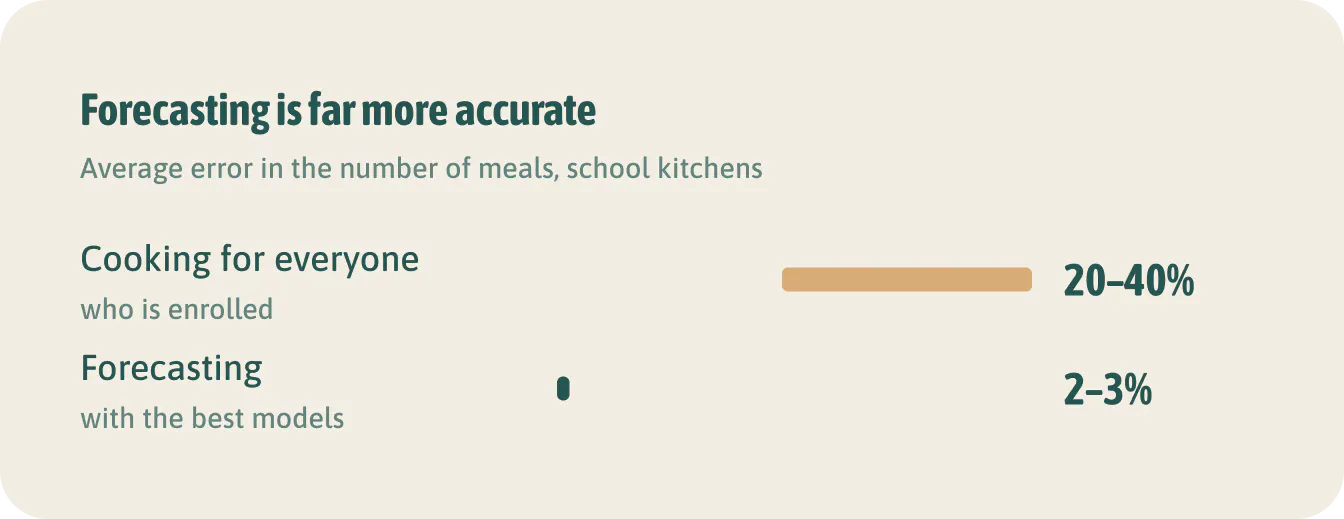
He showed how big the gain could be in schools. There, food was cooked for every enrolled pupil. That estimate was off by 20 to 40% on average. With the best forecasting models, the error fell to 2 to 3%. Malefors adds a warning: a forecast can come in too low, so in practice you always keep some margin.
Then he tested it in practice. In a controlled trial in school kitchens, kitchens tried different measures. Two worked best against food that was prepared but not served: forecasting how many would come, and tracking what was left on plates. They cut that waste by 34 and 38 g per portion. In the comparison group it was 11 g (Malefors et al., 2022).
Two caveats. These are schools and canteens, not restaurants. And it's about knowing how many people will come, not what they'll eat. For a restaurant that takes bookings, the number is the easy part. The split across dishes is the hard part. That's what the next research is about.
What happens when people choose for themselves
People who choose what they eat leave less on the plate. That's best studied in hospitals, where patients have traditionally ordered well in advance, sometimes the day before.
A hospital in Brisbane switched from a fixed menu, ordered well ahead, to room service. Patients ordered what they wanted just before the meal. Plate waste fell from 29% to 12%, and meal costs per patient by 15%. Patients also ate more (McCray et al., 2018).
That's a bigger change than choosing in advance alone. Room service means ordering when you're hungry. But it does show what happens when the choice moves closer to the meal and to the person. We wrote about healthcare earlier in Food waste in hospitals: what works in practice.
The picture isn't equally strong everywhere. A review of five studies on electronic bedside meal ordering found positive effects on intake, satisfaction and costs. On plate waste the evidence was mixed: one study found no difference (MacKenzie-Shalders et al., 2020). So choosing helps most when it really tells the kitchen something, and when the choice matches what someone wants at the time.
It's being tried outside healthcare too. United Airlines now lets economy passengers buy fresh meals only by pre-ordering in the app. The company expects this to keep more than 100,000 pounds of unused food out of landfill each year (Future Travel Experience, 2026). That's the company's own projection, not a measurement.
Why a preference works better than an order
There's a trap. A pre-order that's binding can cause waste of its own.
Researchers followed 946 students over three years in an Italian university canteen where pre-ordering was required. They found signs that pre-ordering could increase the number of orders that were never collected. They call it a source of waste not previously described in the literature (Migliavada et al., 2021). The logic is simple. If an order is binding and someone doesn't come, the food has already been made and is thrown away anyway.
That's why a choice made in advance should be a preference, not an order. Three things help.
- The guest can still change their mind at the table. Then choosing doesn't feel like a commitment, and more people do it.
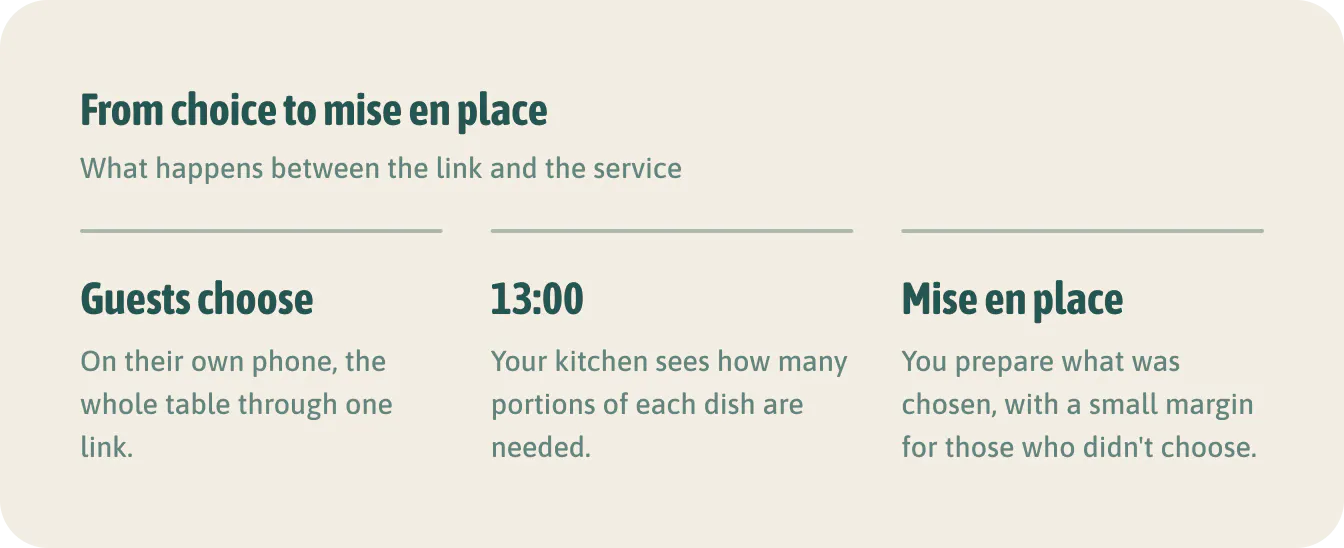
- The kitchen takes stock at the last sensible moment. At a fixed time on the day itself, you see the totals. Whatever changes after that, you absorb with a small margin.
- Cancelling is as easy as choosing. A guest who can't come after all says so through the same link. You hear about it sooner and don't make their portion.
Events work the same way. Guidelines for sustainable meetings advise having guests register and give their dietary needs in advance, so the caterer has an accurate count and can plan a menu that avoids waste (WMA, 2022). More in Food waste at events and catering: where it goes wrong.
What it means for your mise en place and purchasing
A list of choices changes nothing if the kitchen doesn't use it. Here's how.
Prep to the totals. When choices close, you see how many portions of each dish were chosen. Base your prep on that. Not every guest chooses in advance, so the list is a minimum. For the rest of your guests, use your usual split across dishes, and keep a small margin.
An example. Say 60 guests are coming tonight and 24 of them chose in advance. Of those 24, 12 chose the fish, 8 the meat and 4 the vegetarian dish. For the other 36 guests, you use your usual split. But you already know the fish will be popular tonight, and that you need less of the vegetarian dish than you might think. It's a worked example, not a measurement.
Comments and allergens. A guest who mentions a nut allergy in advance doesn't have to explain it again at the table. The kitchen knows before the first ticket comes in. That also saves special portions made just in case. More in Allergens and dietary needs in hospitality: rules and practice.
Purchasing to the pattern. After a few weeks you see which dishes are chosen often and which rarely. That helps with ordering. A dish almost nobody picks costs a lot of mise en place for few plates. Maybe it can come off the menu, or be made in smaller batches.
Measure what's left. Asking in advance tells you what's coming. Measuring tells you what goes in the bin. Together they show whether choosing makes a difference. How to measure is in Measuring food waste in restaurants: what it costs and where to start.
What we don't know yet
Research from three directions shows that asking in advance works:
- school kitchens, where knowing how many would come cut overproduction;
- hospitals, where choosing close to the meal cut plate waste;
- a canteen, where binding pre-orders created new waste. That's why a menu choice in Waste Warrior is a preference, not an order.
In restaurants, we saw it in the pilot at Bij Bram in Utrecht. There, 40% of guests with a booking gave their choice in advance. Visibly less food was thrown away, and the kitchen was calmer (KHN, April 10, 2026, in Dutch).
You'll see the biggest effect at restaurants that are fully booked in advance. And the more guests choose, the more accurate the list.
Want to see in black and white what it achieves in your kitchen? Combine menu choice in advance with Waste Warrior Monitor. Measure for a few weeks before you start, and again afterwards in the same way. That gives you the complete package: ask in advance, and measure what it achieves. What menu choice in advance does for no-shows is covered in No-shows in restaurants: what they really cost and what helps.
How Waste Warrior helps with menu choice in advance
Nothing changes in how your guests book. They book through your own booking system or the booking button on your website. If you use your own booking system, bookings, changes and cancellations come into Waste Warrior automatically. You don't need to set anything up; Waste Warrior makes the connection.
After booking, the guest gets a WhatsApp message or email with a personal link. They share it with the rest of the table. Everyone picks a dish from your menu on their own phone, with no app or account. For each dish, guests see the allergens: the 14 EU allergens. In the comments field they can mention an allergy or a request. If not everyone has chosen and the booking is more than a day away, a reminder follows the day before. If a guest can't come after all, they can say so on the same page.
Choices close at 13:00 on the day itself by default; you can change that time. Your kitchen then sees under "Kitchen" and "Totals" how many of each dish are coming, per course, with the comments alongside. For each booking you can also see who chose what. As an extra nudge, you can offer a discount per response. Whether you do, and how much, is up to you.
Messages go by email and WhatsApp. The messaging system isn't tied to one channel, so we can add another on request, such as Signal. How to set it up is in Setting up reservations with menu choice in advance, step by step. Short answers are in the FAQ on menu choice in advance. The bigger picture is in Food waste in hospitality: the complete guide.
Curious what your guests get and what your kitchen sees at 13:00? Take a look at menu choice in advance or plan a demo.